
A new book arrives on Amazon with little behavioral history. No meaningful sales velocity. Few or no reviews. Limited click history. Minimal conversion data. Those are exactly the signals Amazon's search-ranking systems use to decide which products deserve visibility for a given query.
That creates the familiar cold-start loop: the book needs visibility to generate sales, but Amazon often needs sales before it gives the book more visibility.
Publishers have usually attacked this problem upstream. Pre-orders create early sales velocity. Advance copies help generate review signal. Pre-launch advertising buys attention before organic visibility exists. Those tactics still work. But Amazon has now described another mechanism: using the behavior of similar products to give new products a stronger starting position.
That changes how launch metadata should be understood. Metadata is descriptive copy, and it also helps determine which existing products Amazon treats as similar to the new book. If Amazon assigns the book to the right competitive neighborhood, the book may benefit from stronger inherited behavioral signals during the cold-start window. If the metadata is vague, contradictory, or miscoded, the book can be placed in the wrong neighborhood and lose that advantage.
The commercial question for publishers is therefore simple: does the book's launch package make the right substitutes obvious?
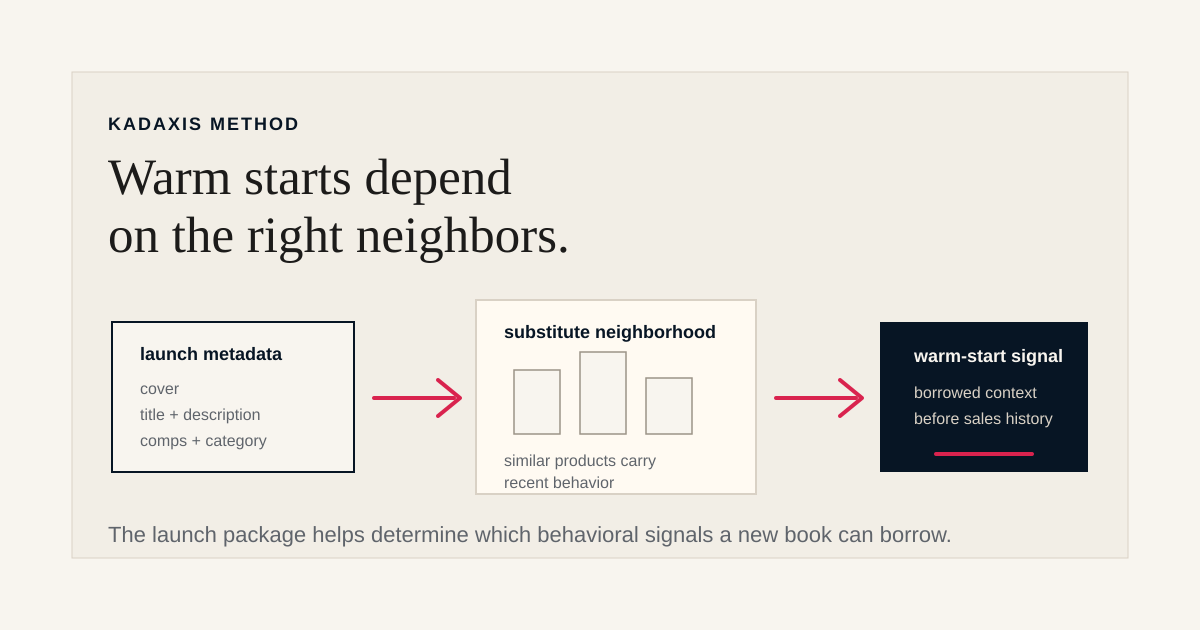
How Amazon builds a warm-start neighborhood
Amazon researchers describe a production system called Behavioral Feature Boosting via Substitute Relationships, or BFS. The system is designed to mitigate cold start by identifying substitute products and transferring useful behavioral signals from those substitutes to products with little or no history of their own.
The mechanism is the point. A new product with no sales history can still be ranked partly through the recent behavior of similar products.
For books, that makes the substitute set commercially important. The books Amazon decides are similar to a new title can influence the early signal environment around that title.
The mechanism has four parts.
1. Amazon identifies substitute products. Amazon reads the product's available digital signals together: cover image, title, subtitle, description, bullet points, and category labels. Those signals are combined into a representation of what the product is, and products with similar representations become substitute candidates.
The research names BLIP2 as part of the underlying architecture. For publishers, the practical implication is that text and image signals are evaluated together. The cover is not isolated from the description. The title is not isolated from the category. The total package contributes to the product neighborhood Amazon sees.
A book whose cover, title, description, and category all signal literary fiction with an introspective female protagonist is more likely to be grouped with books that share that market position. A book whose signals conflict - literary cover, thriller-flavored description, broad general-fiction categorization - gives Amazon a noisier substitute problem.
2. Amazon transfers behavioral signal from the substitutes. Once substitutes are identified, the system uses their recent sales activity to estimate a stand-in behavioral feature for the new product. The primary signal described in the paper is Sales Velocity, a recency-weighted measure of recent sales.
The paper's qualitative example is a Pilot fountain pen. The product's actual Sales Velocity was 89. Its substitute set averaged a Sales Velocity of 297. That substitute-based signal moved the product from rank 8 to rank 3 in the search results.
The product itself did not change. The system changed the behavioral context Amazon could use to rank it.
3. Amazon uses the substitute signal only when it helps. The safeguard is important. The system does not let substitute behavior drag a product down. If the product's own behavioral signal is stronger than the substitute average, the product keeps its own signal. If the substitute average is stronger, the product can benefit from the substitute signal.
For a new book with little or no behavioral history, that makes the warm-start signal especially valuable. The book has little to lose and potentially meaningful early visibility to gain.
4. Amazon validated the system in production. The paper reports a four-week A/B test comparing the BFS-enabled ranking model against the production baseline. The model improved total dollar sales by 0.11 percent, total units sold by 0.22 percent, and dollar sales of new products by 0.18 percent. The largest reported lift was in units sold for new products, at 0.35 percent.
Those are small percentages on a large baseline, which is typical for mature search-ranking systems. The strongest lift was where the cold-start theory predicts it should be, among new products. The system went into production after the test and has been live on Amazon's search platform since 2025.
What this means for publisher metadata
The Amazon paper is not book-specific. BFS operates across Amazon's e-commerce search platform, which includes books but is not limited to books. The books vertical may have additional tuning, filters, or category-specific behavior that the public paper does not describe.
Even with that limit, the implication for publishers is clear. Launch metadata helps Amazon decide what a new book is similar to. Similarity affects the substitute set. The substitute set can affect the warm-start signal. The warm-start signal can affect early visibility.
That gives several familiar metadata decisions a more direct ranking consequence.
Comp-title language helps define the book's ranking neighborhood
Comp-title language has always helped human buyers, sales teams, reviewers, and readers understand where a book sits in the market. Under a substitute-based warm-start system, it can also help Amazon understand which existing books the new title belongs near.
A description that says a novel is for readers of Susanna Clarke, in the tradition of Donna Tartt, or suitable for fans of Pachinko is doing more than positioning. It is sending Amazon explicit signals about the book's market neighborhood.
That does not mean every book description should be stuffed with famous names. Weak or inflated comps can create the wrong neighborhood, which is worse than a narrower but more accurate signal. The strategic question is whether the comps make the book's true reader market clearer.
Good comp-title language should identify the right adjacency: books whose readers, themes, format, tone, and commercial context plausibly overlap.
Cover design has cold-start implications
Cover design has always affected conversion. In search results, readers make fast genre and quality judgments from the thumbnail. A cover that miscodes the book can depress clicks even if the book is ranking.
Amazon's substitute system adds another layer. If cover images are part of the substitute-identification process, then cover design can also influence which products Amazon groups together before the reader even sees the book.
A literary novel that visually resembles literary fiction is more likely to sit in the right visual neighborhood. A cozy mystery that looks like a domestic thriller creates ambiguity. A romance package that looks like general women's fiction may attract the wrong substitute set.
Generic covers are not the answer. The answer is legible market signaling. Distinctiveness helps after the book is in the right neighborhood. If the visual signal points to the wrong neighborhood, distinctiveness can become noise.
Category accuracy affects the quality of inherited signal
Category placement is one of the cleanest operational implications. Substitute systems commonly constrain or weight candidates by category. If a book is in the wrong category, or only in a broad parent category, it is more likely to inherit signal from a weaker or less relevant substitute set.
A historical romance categorized broadly under Literature & Fiction is less discoverable through category browsing. It may also be asking Amazon to compare it against the wrong behavioral neighborhood. The inherited signal becomes diluted, noisy, or misdirected.
This makes BISAC and retail category mapping more than housekeeping. It is part of launch-rank hygiene. Technical accuracy is the floor. The goal is to place the book where its strongest true substitutes already live.
Description copy should reduce ambiguity
A book description is often treated as persuasion copy: hook, stakes, tone, payoff. That remains true. But in a system that reads product text for substitute identification, description copy also needs to reduce machine ambiguity.
The description should make the book's genre, subject, reader promise, tone, and market adjacency clear. It should avoid blending incompatible signals unless the hybrid positioning is deliberate and supported elsewhere in the package.
For publishers, this creates a useful discipline. Ask whether the description would help a search system distinguish the book from adjacent but wrong neighborhoods. Literary suspense is not the same as procedural thriller. Narrative history is not the same as academic monograph. Cozy fantasy is not the same as epic fantasy. The description should make those distinctions easier, not harder.
Pre-launch metadata is a compounding decision
The cold-start window is short, but it is disproportionately important. Early visibility drives early clicks. Early clicks and conversion drive sales. Sales become the book's own behavioral history. Once that happens, the book is no longer relying only on borrowed signal.
Good launch metadata can therefore compound. It helps Amazon identify better substitutes. Better substitutes can produce a stronger warm-start signal. Stronger early visibility can generate more sales. More sales become the book's own ranking signal.
Bad launch metadata compounds in the other direction. The book is assigned to a vague or wrong neighborhood. The warm-start signal is weaker. Initial visibility is lower. The book accumulates less behavioral history. Organic ranking becomes harder precisely when the book most needs momentum.
What publishers should audit before launch
The practical application is straightforward: before publication, audit whether the launch package makes the right substitute set obvious.
The strongest checks are:
- Category fit: Is the book placed in the most commercially specific accurate categories, rather than a broad fallback category?
- Comp fit: Do the named or implied comps reflect real reader, tonal, subject, and format adjacency?
- Cover-code fit: Does the cover signal the correct genre or subject area at thumbnail size?
- Description clarity: Does the product description make the book's true market position easier to identify?
- Signal consistency: Do cover, title, subtitle, description, keywords, and categories all point to the same neighborhood?
- Wrong-neighbor risk: Which successful books would be bad substitutes, and does anything in the metadata accidentally point toward them?
That last question is useful because it forces precision. Metadata strategy adds attractive terms and prevents the wrong interpretation.
What Amazon's warm-start system does not solve
BFS is a mitigation mechanism, not a bestseller machine. The reported aggregate lifts were under one percent, and the paper's qualitative example shows a meaningful rank improvement for a specific product, not a universal guarantee.
The system also depends on substitute quality. If the metadata package is sparse, generic, inconsistent, or miscoded, Amazon has less to work with. A substitute-based system cannot reliably infer the right neighborhood from unclear inputs.
Finally, the public paper describes Amazon's general e-commerce search system, not a book-specific implementation manual. Publishers should not assume they know every feature weight or category rule inside the books vertical.
The right conclusion is narrower and stronger: Amazon has productionized a system that uses substitute relationships to improve ranking signals for cold-start products. For books, the metadata package is one of the clearest publisher-controlled inputs into those substitute relationships.
The strategic takeaway
The cold-start problem used to be framed mainly as a lack of pre-launch demand. A book had no sales history, so the publisher had to create early signal through pre-orders, advance reviews, publicity, and advertising.
Those levers still matter. But Amazon's warm-start research shows another layer: the platform can borrow signal from similar products when a new product has little history of its own.
That makes metadata strategy more consequential. The cover, title, subtitle, description, comp-title language, keywords, and category placement together help define the book's launch neighborhood. That neighborhood can influence the behavioral signal Amazon uses during the period when the book has the least signal of its own.
For publishers, accurate description is the floor. The stronger objective is to make the book's true commercial neighborhood unmistakable.
The books that get the cleanest warm start are likely to be the books whose metadata makes the right substitutes obvious.