
Research · Notes from the Field
Research on how readers find books in Amazon search and AI tools.
Findings, methods, and practical questions for publishing teams.
Common questions on book discovery.
-
Should book keywords be single words or search phrases?
Should Book Keywords Be Single Words or Search Phrases? -
Do book keywords actually work on Amazon?
ONIX keywords work. Most keywords that publishers create don't. -
What makes a book keyword effective?
The narrow space where keywords actually work -
Is Amazon keyword metadata limited to 250 characters?
Amazon Keywords Don't Stop at 250 Characters. Publishers Do. -
How do books show up in ChatGPT and AI search?
How books show up in ChatGPT and AI search
More questions (10)
-
Which sources does ChatGPT use to recommend books?
Where AI book recommendations come from -
Should keywords repeat information already in the title, description, or categories?
Not every keyword is doing work -
Should different formats of the same book use different keywords?
Different keywords on different formats of the same book -
Do book descriptions affect Amazon search visibility?
Your book description is a search surface -
When should a keyword include the word “book”?
When to put "book" in a keyword -
How can publishers match books to reader needs in ChatGPT?
GEO and AEO for publishers: Matching books to reader needs -
Should book keywords be extracted from the manuscript?
Why book keywords don't live inside the book -
What has to happen for a book to become visible in Amazon search?
The discoverability funnel -
Does metadata affect how a new book ranks at launch?
Amazon's warm-start research makes launch metadata a ranking decision -
How common are single-word keywords in publisher metadata?
Nearly half of publisher keywords are a single word
Start here
A starting point for your team.
Metadata teams
Begin with the evidence on words, phrases, and the keyword field.
Start with search phrases →Marketing teams
Understand how AI answers retrieve information and connect books to readers.
Start with AI discovery →Publishing leaders
Get a short overview of the findings, services, and what an engagement delivers.
Read the publisher brief →Amazon search and keywords
 RESEARCH
 Should Book Keywords Be Single Words or Search Phrases?
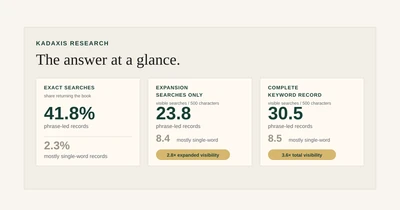
We conducted a study that found natural reader-search phrases made far better use of limited keyword space than tag-based single-word keywords. Search phrases produce substantially more visibility when searched directly or in expanded search forms.
 RESEARCH
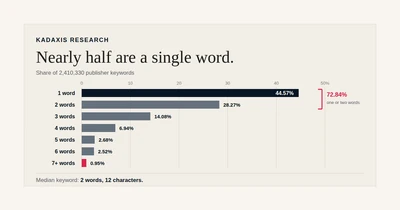
 Nearly half of publisher keywords are a single word
We analyzed 2.4 million keywords across 94,385 books. Single-word keywords make up 44.57% of the total, by far the largest share. A quarter of the books carry no keywords at all. When publishers use the field, they add a median of 26 keywords per book. Effort is not the problem. Shape is.
 RESEARCH
 Your book description is a search surface
Descriptions are written for readers who already found the book. New Kadaxis research shows Amazon also indexes them: phrases appearing nowhere else on a listing surface the book in organic search about 1.6% of the time, roughly 260 times the matched-control rate. The effect is real, small, and strongest for distinctive language.
 RESEARCH
 ONIX keywords work. Most keywords that publishers create don't.
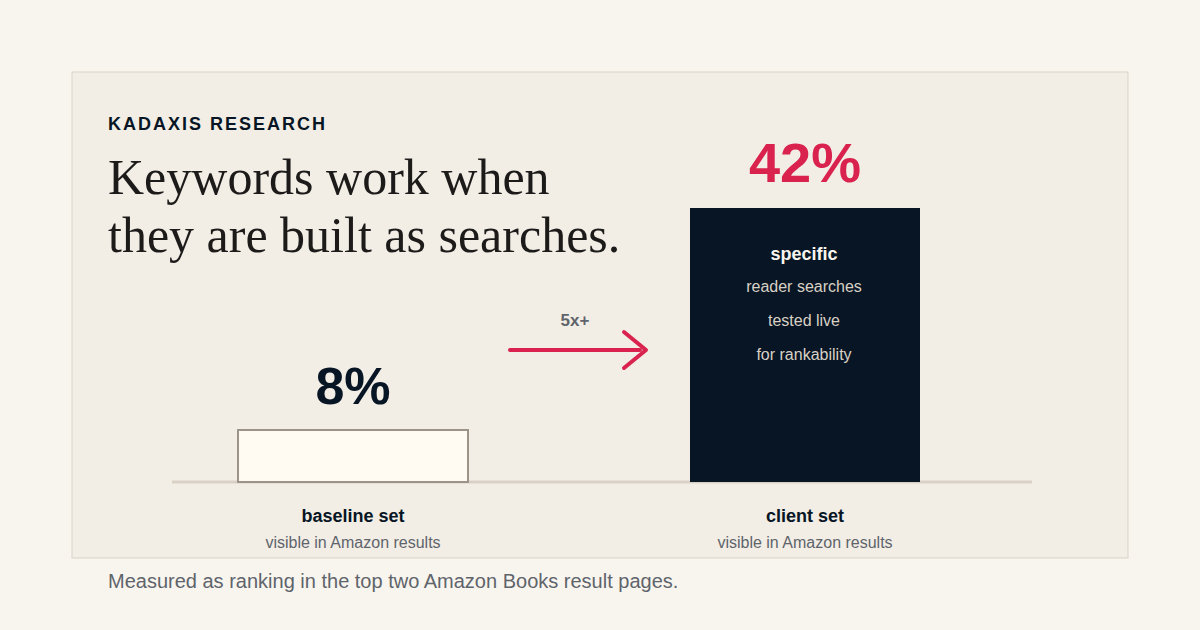
Plenty of people in publishing suspect keywords do not work. Recent Kadaxis research shows why: only about eight percent of publisher-assigned keywords rank in Amazon search. Keywords built for 2,000 books from a recent Kadaxis client ranked forty-two percent of the time.
 METHOD
 When to put "book" in a keyword
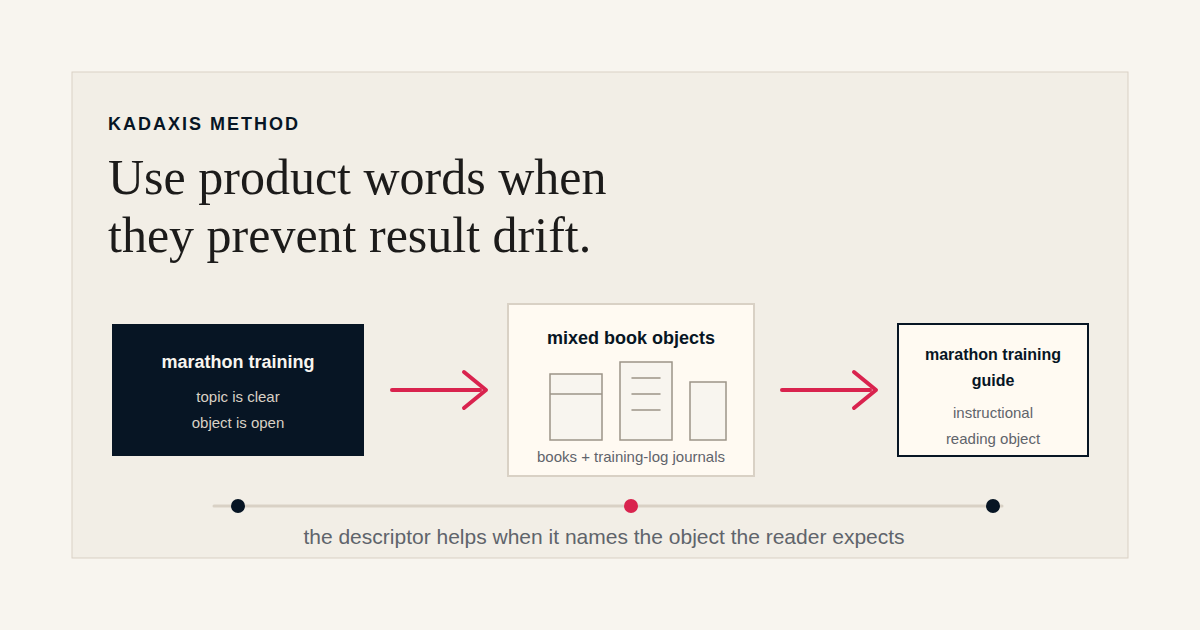
The old advice was simple. Never spend keyword space on product descriptors, because the retailer already knows the product is a book. That rule is too crude. Product descriptors carry real retrieval value when they tell the search system what kind of object the shopper wants. They turn into waste only when they repeat what the catalog already supplies or force an unnatural phrase.
 METHOD
 Keyword portfolio ordering
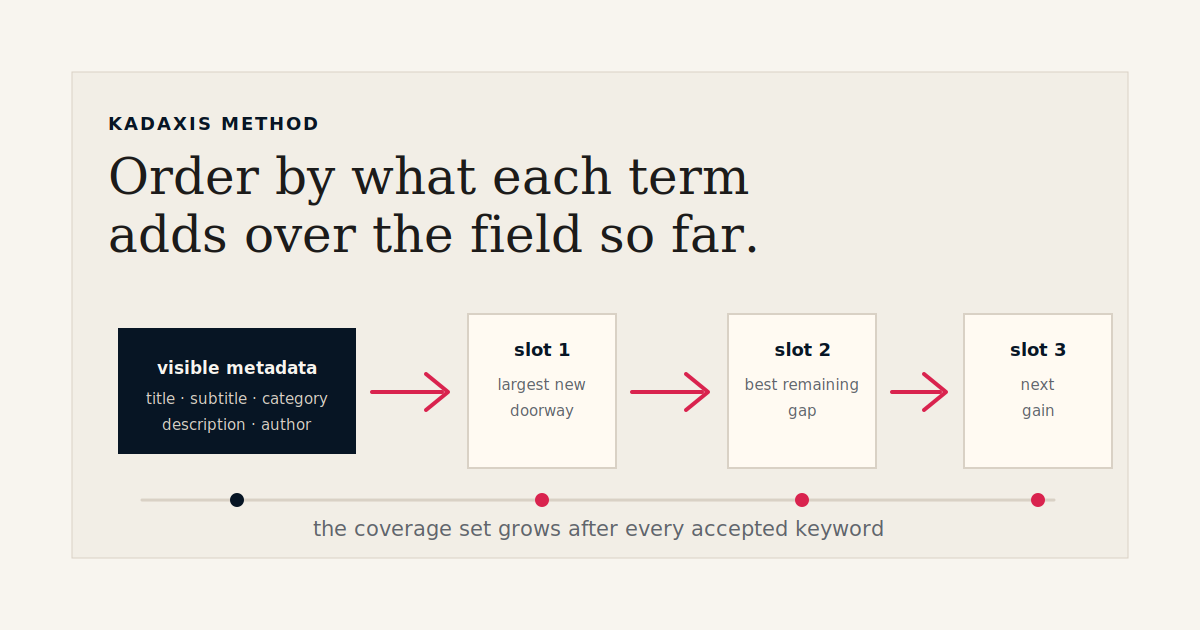
A keyword portfolio is an ordered coverage system. The first keyword is measured against the book's visible metadata. The second, against that metadata plus the first keyword. Every position is judged by what it adds over everything above it, so a lower-scoring keyword can outrank a higher-scoring one when it reaches readers the rest of the portfolio has missed.
 METHOD
 Keyword portfolio allocation
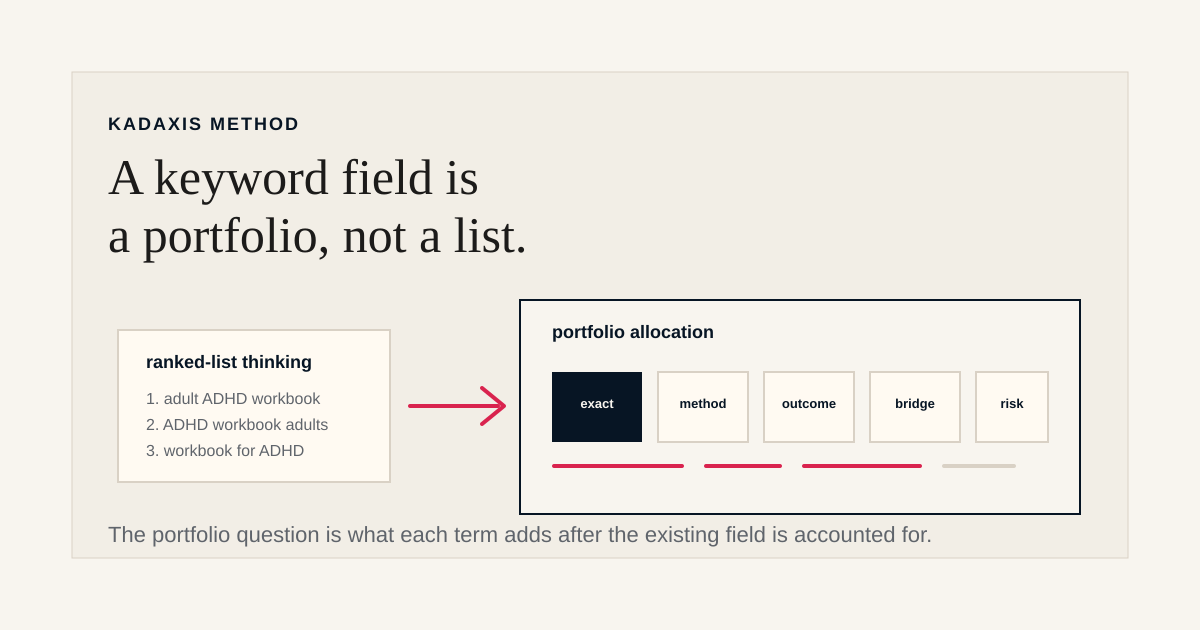
Most keyword strategy is treated as a ranking problem: generate candidates, score them, keep the top N, ship the list. That works at the individual-keyword level but fails at the portfolio level. A keyword buys access to a search doorway: a cluster of reader intent, search results, substitute books, and commercial expectations. Portfolio strategy is deciding which doorways deserve scarce metadata space, which overlap, and which introduce risk.
 RESEARCH
 Amazon's warm-start research makes launch metadata a ranking decision
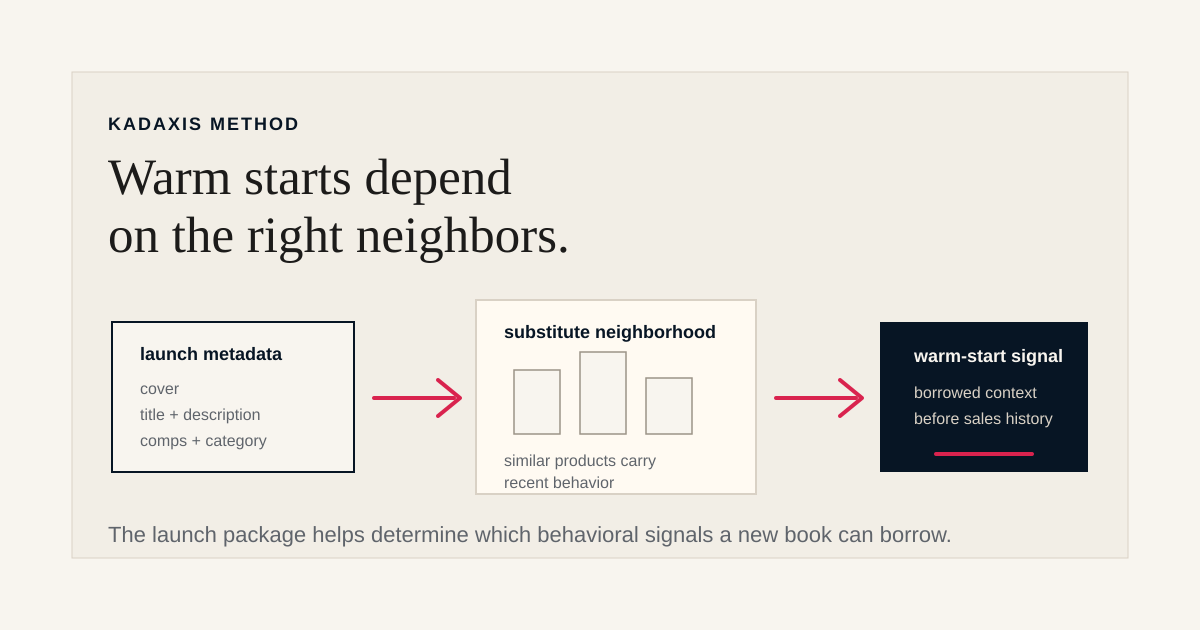
Amazon has described a production search-ranking system that uses substitute products to give new products a warm start before they have sales history of their own. For publishers, the implication is direct: cover, title, description, comp-title language, and category placement help determine the behavioral neighborhood a new book enters at launch. That neighborhood can shape early visibility, sales velocity, and the book's ability to build its own ranking signals.
 METHOD
 The discoverability funnel
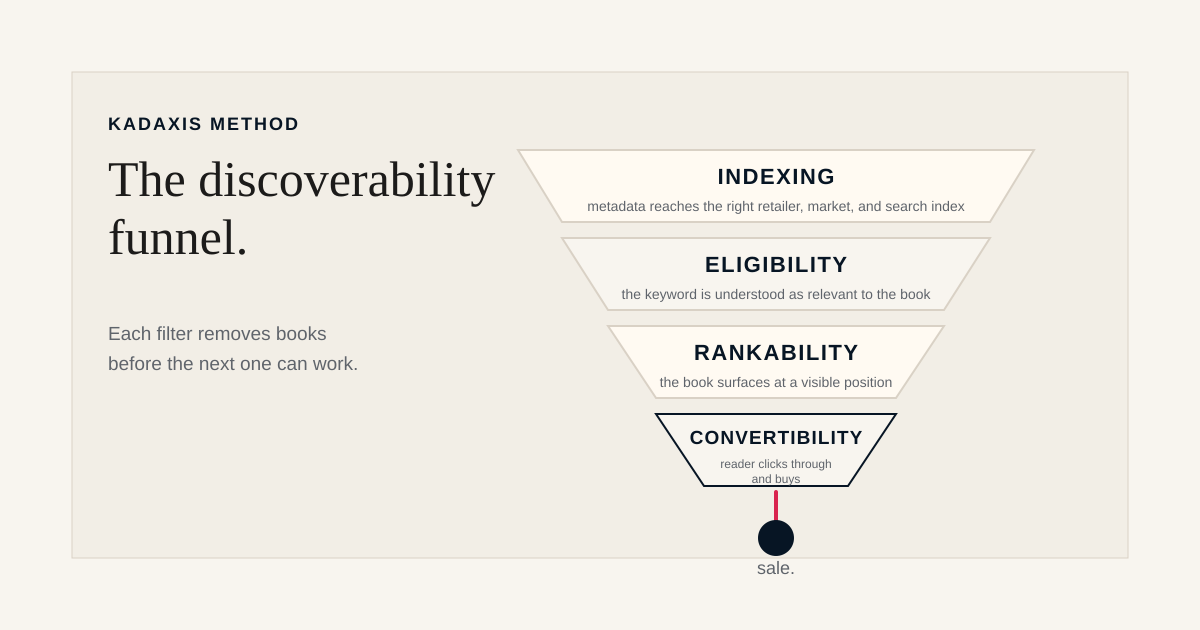
Amazon accounts for roughly half of US print book sales and two-thirds of US ebook sales, and most US consumers now start their online product searches on Amazon rather than Google. The path from a book's metadata to a reader's purchase runs through a funnel with four sequential filters. Most candidate books drop out at one of them.
 METHOD
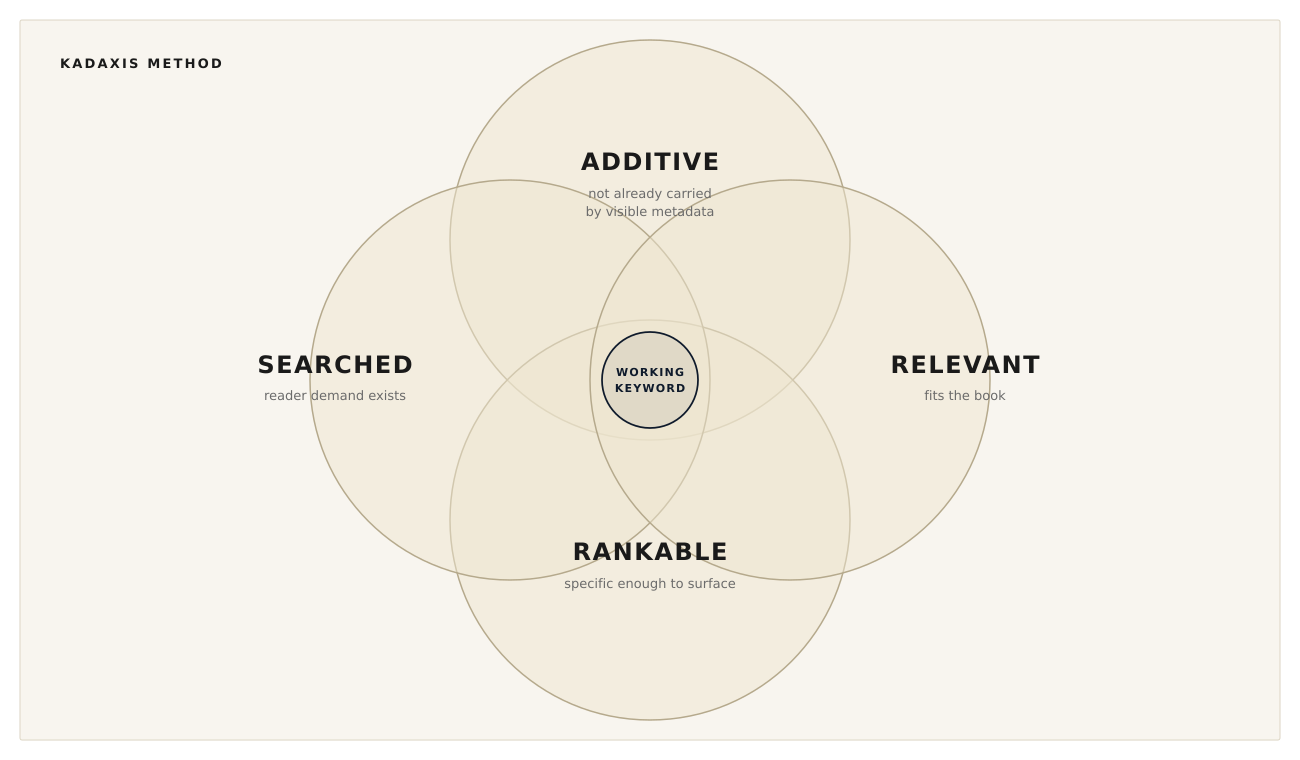
 The narrow space where keywords actually work
For a book keyword to do anything useful, it has to clear four independent tests: someone has to be searching for it, Amazon has to consider the book relevant to it, it has to add signal the rest of the metadata does not already supply, and the book has to be able to rank for it. Most keyword candidates fail at least one.
 METHOD
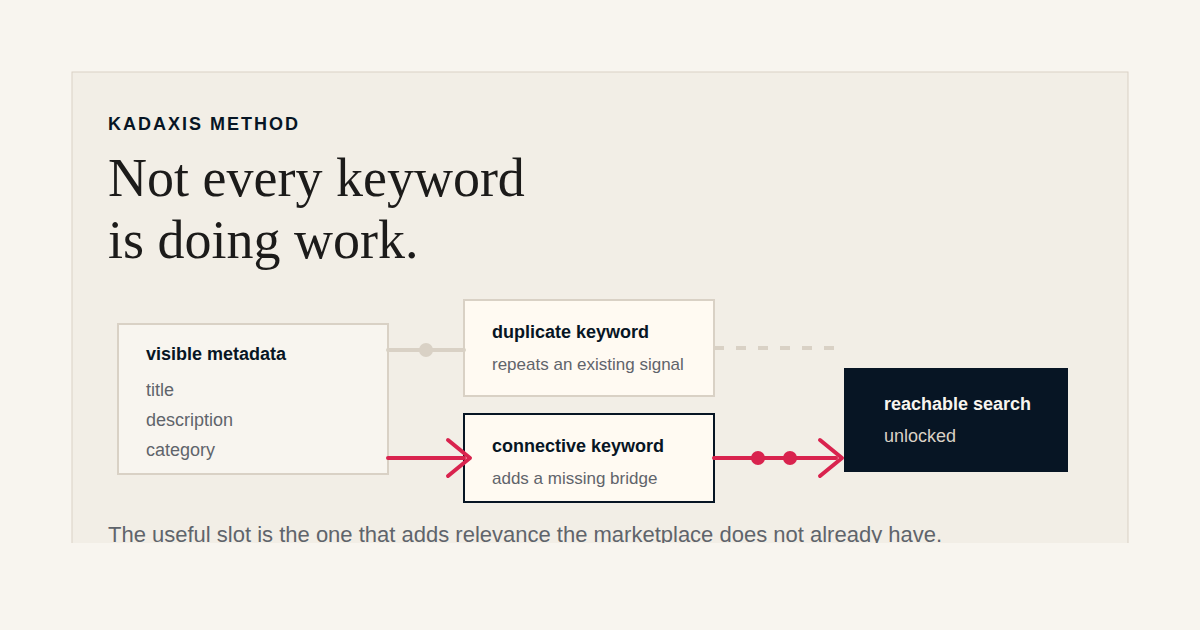
 Not every keyword is doing work
In our recent analysis, only about eight percent of publisher-assigned book keywords produced a visible match in retailer search. The other ninety-two percent are not wrong; they are mostly repeating signals the rest of the metadata already supplies.
 METHOD
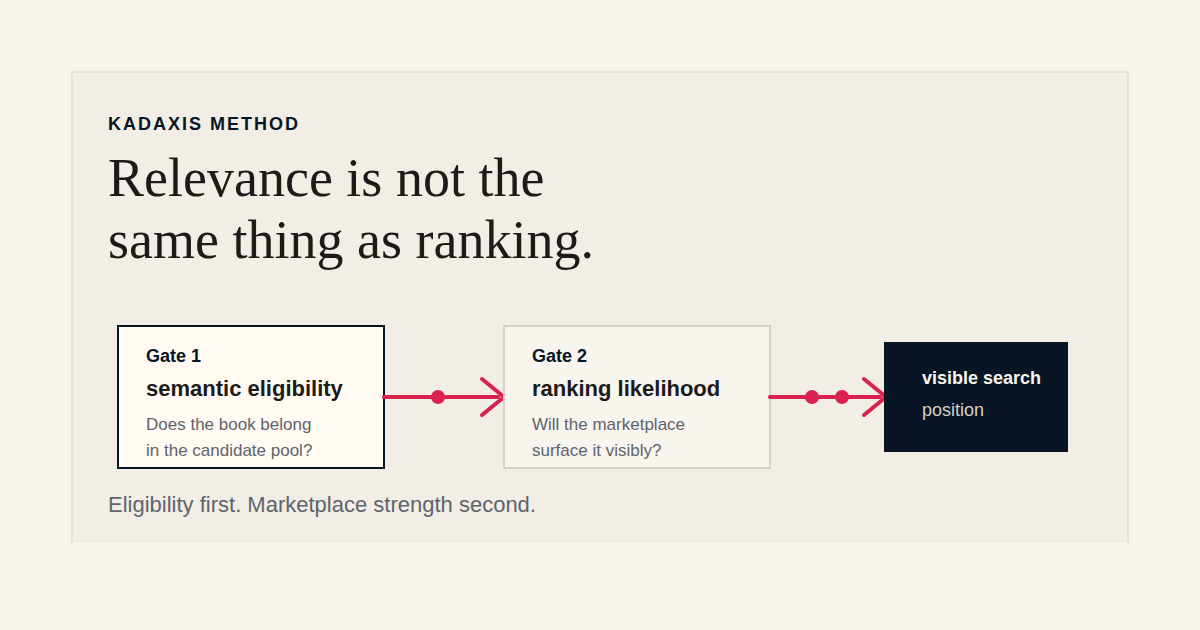
 Relevance is not the same thing as ranking
Most keyword strategies treat search visibility as a single problem. It is two problems, in sequence, and confusing them is why so much keyword work fails to move performance.
 FIELD NOTE
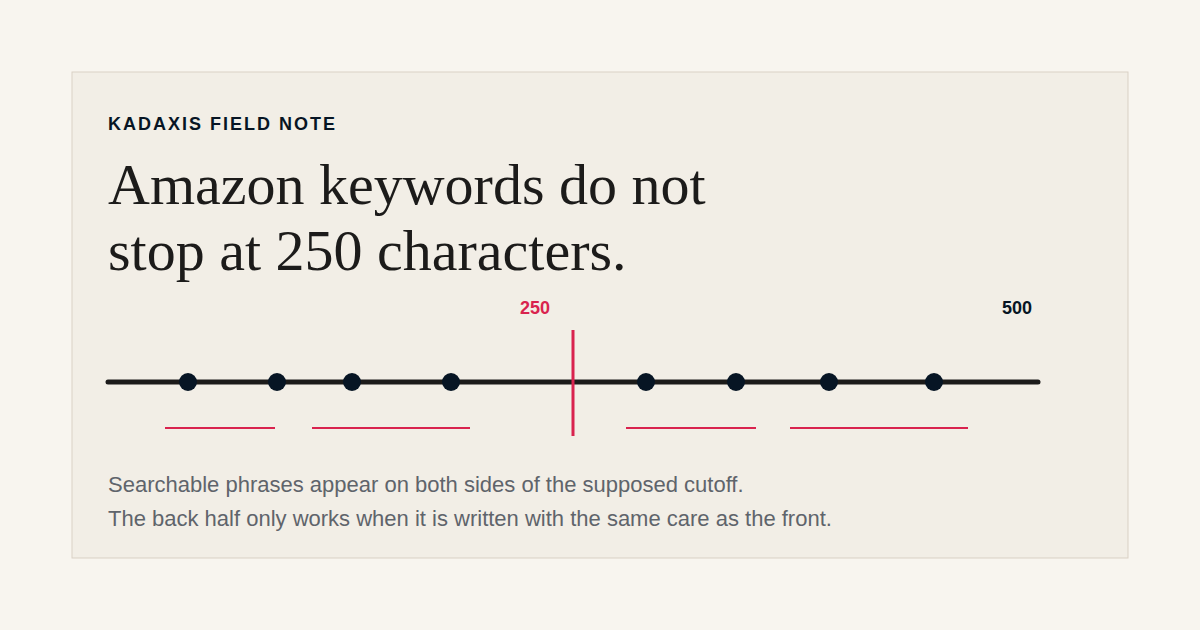
 Amazon Keywords Don't Stop at 250 Characters. Publishers Do.
A direct look at whether Amazon ignores ONIX keyword phrases after 250 characters, and what publishers should actually do with the field.
 COMMENTARY
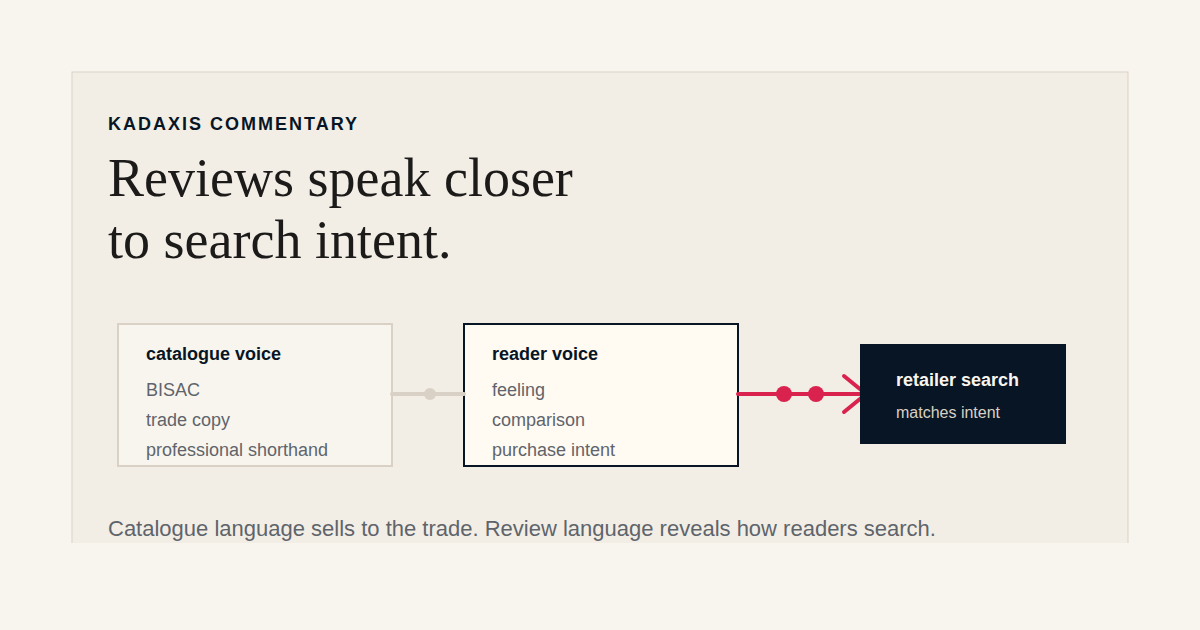
 What reader reviews know that catalogues don't
Catalogues describe books in the trade's language. Readers search in their own. The gap between those two registers is where most of the lost sales live.
 METHOD
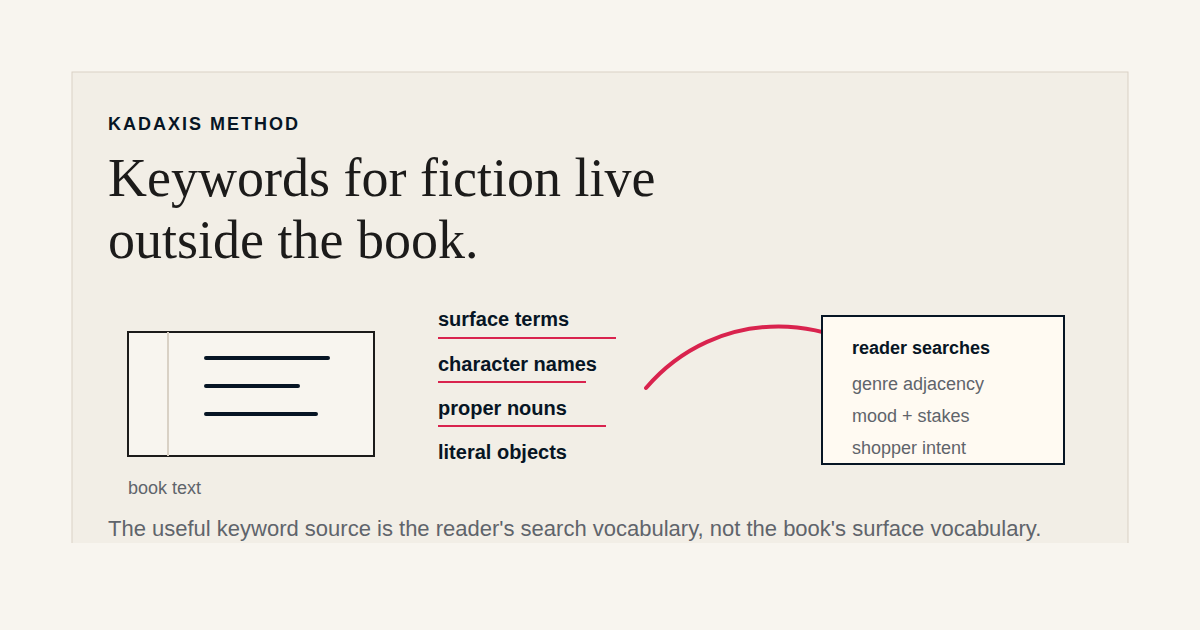
 Why book keywords don't live inside the book
Most keyword tools start with the text of the book. The text has value, but reader search often lives in a different vocabulary: need, outcome, comparison, emotional texture, and intent.
 RESEARCH
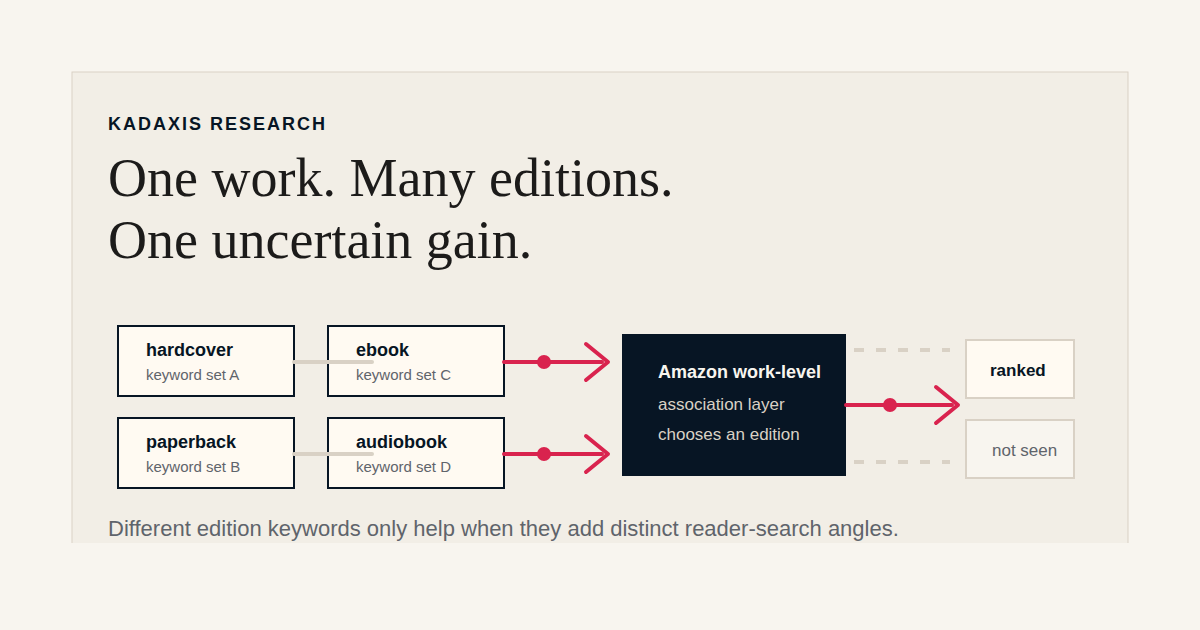
 Different keywords on different formats of the same book
A common piece of advice is to assign different keyword sets to the hardcover, paperback, ebook, and audiobook editions of the same title to expand the work's reachable search surface. We tested whether this works at scale. The phenomenon exists in specific cases, but our data does not support recommending it as default practice.
AI discovery
 RESEARCH
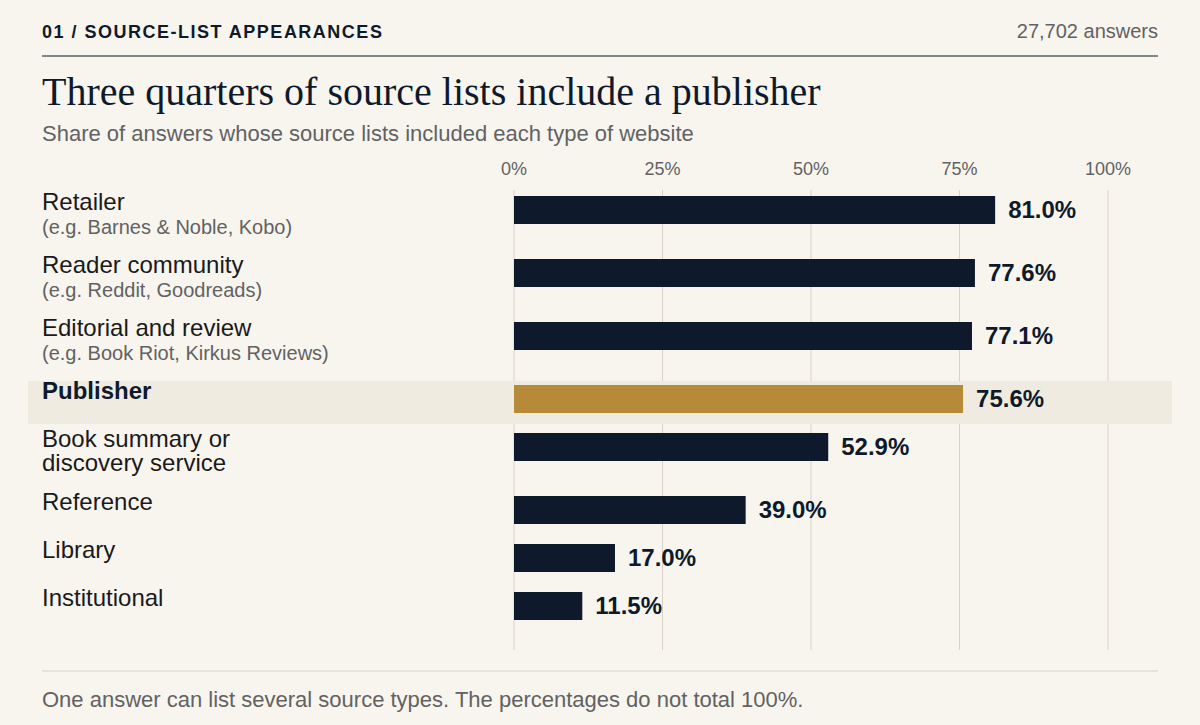
 Where AI book recommendations come from
Publisher websites appeared in three quarters of the ChatGPT source lists we examined. Our study of 27,702 answers to reader requests looks beyond the familiar website names to the book descriptions, reading guides and other pages that surfaced, and what publishers can learn from them.
RESEARCHGEO and AEO for publishers: Matching books to reader needs
Reviews show why readers choose a book and how they use it. Connecting those insights with customer demand and ChatGPT’s recommendations helps you decide what to explain in your descriptions, which material to share, and where to publish it so the right readers can discover your books.
 FOUNDATIONS
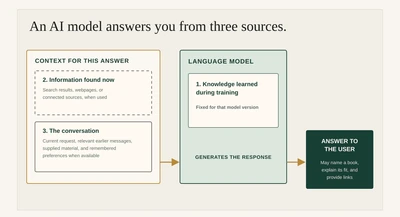
 How books show up in ChatGPT and AI search
To improve a book’s visibility in ChatGPT and AI search, publishers need to understand what informs an answer and which components they can influence.
Publishing intelligence
 COMMENTARY
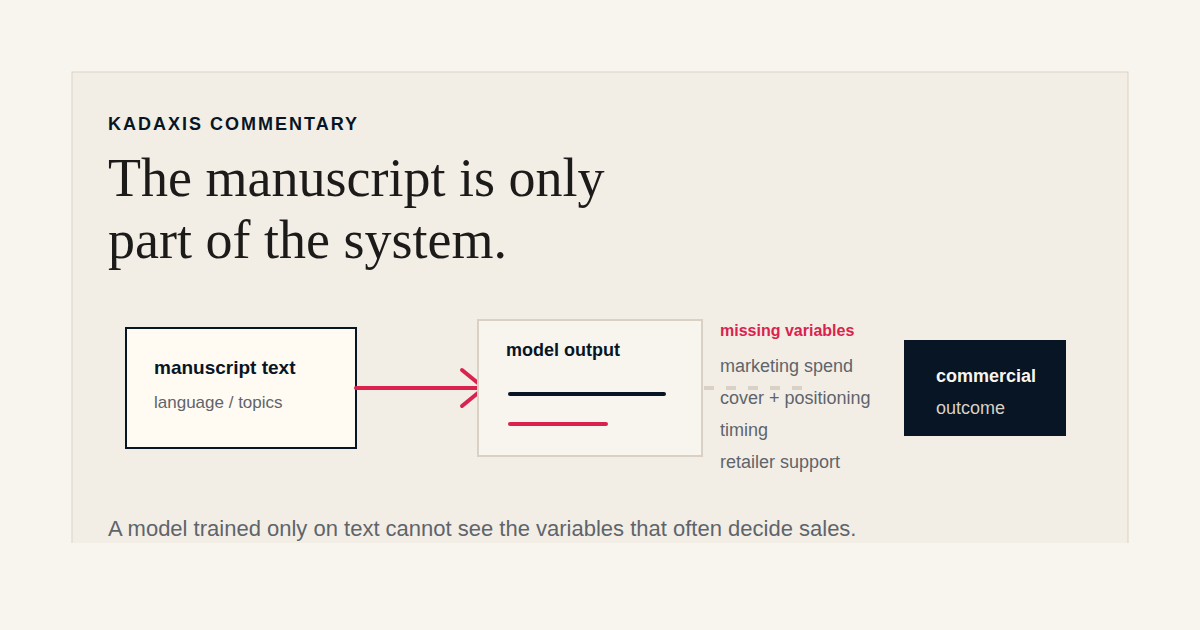
 What we learned trying to predict bestsellers
A year of work on bestseller prediction from manuscript text produced a working system and a clear lesson: the model was answering the wrong question, and the right question requires variables the manuscript cannot supply.
 METHOD
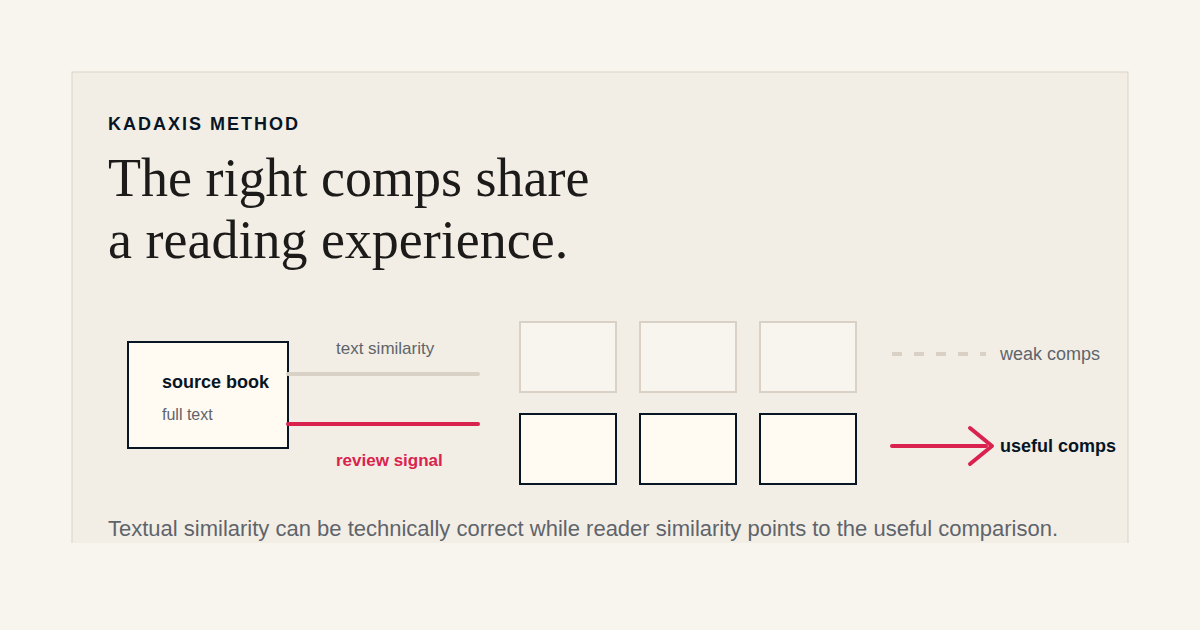
 Why comparable titles fail when derived from book text
Most automated comp-title tools operate on the text of the book. The comparisons readers and the trade actually make operate on something the text cannot fully capture: the reading experience.
Archive, 2015 to 2018 (10 articles)
How Top Publishers Use Keywords
A study of 150,000 publishers, conducted with Bowker and Firebrand, on how the industry was actually using metadata keywords and where the practice was still falling short.
METHODWhy a 500-Character Keyword Limit Is Costing You Book Sales
The widely accepted ceiling for keyword metadata is wrong, and the cost compounds across a list.
FOUNDATIONSHow Amazon Search Really Works
A working explanation of the algorithm that determines which books are surfaced and which are not.
METHODMeasuring Keyword Effectiveness on Amazon
A practical framework for assessing whether metadata keywords are working once they are deployed.
RESEARCHHow Do Keywords Impact Sales?
Why search visibility, sales history, and metadata quality reinforce each other over time.
RESEARCHWho Uses the Keywords in Metadata?
A look at how publishers and retailers were using ONIX keywords, and why Amazon was the outlier.
COMMENTARYBISG 2017 Annual Meeting - Rights, Metadata and Marketing Panel
A panel response on rights, metadata, marketing, and the infrastructure around book discovery.
FOUNDATIONSWhat are off-page keywords?
An evergreen definition of off-page keywords and how retailer search engines use them.
COMMENTARYMachine Learning and Bestseller Prediction: More Than Words Can Say
Why book sales cannot be predicted by text alone, and what machine reading can and cannot explain.
METHODHow A Keyword Sells A Book On Amazon
A simple model for how one metadata keyword can influence retailer search and sales.
How we use AI in our note write-ups
Our notes start with research: published papers, retailer search behavior, metadata analysis, live search results, and performance data from keyword work we have done for publishers. We often draft from dictated notes using speech-to-text tools, then use language models to help organize structure and refine prose. The analysis, claims, and final edits are ours.