
For years the standard advice on book keywords carried a firm instruction: do not spend keyword space on product descriptors like book, ebook, novel, or nonfiction. The retailer already knows the product is a book. Amazon files it as a book, shelves it in book categories, and shows it in book search. Using a keyword slot to say book looked like telling the catalog something it already knew.
The advice was reasonable, and for the most generic cases it still holds. Appending "book" to a phrase that is already unmistakably about books adds nothing. As a blanket rule, though, it is too crude, and the reason comes out of how retailer search decides what a query is asking for.
Product-type intent
Amazon's published search research puts weight on a specific idea: the product type a shopper has in mind is part of the query's meaning, and getting it wrong produces visibly bad results. The standard example is a search for a dishwasher that returns dishwasher accessories. The words overlap. The intent does not. The shopper wanted an appliance and got a rack and a box of detergent tabs. Amazon gives explicit weight to product-type tokens to keep that kind of defect out of the top results.
In books, words like book, memoir, workbook, guide, journal, novel, and textbook are product-type tokens. They tell the system what kind of object the shopper wants. On Amazon this is concrete, because the same phrase can return different kinds of book products. A search for "marathon training" pulls up training books alongside training-log journals. The phrase names the topic and leaves the object open. "Marathon training guide" closes it: the reader wants instructional material, not a logbook. The descriptor preserves the intent.
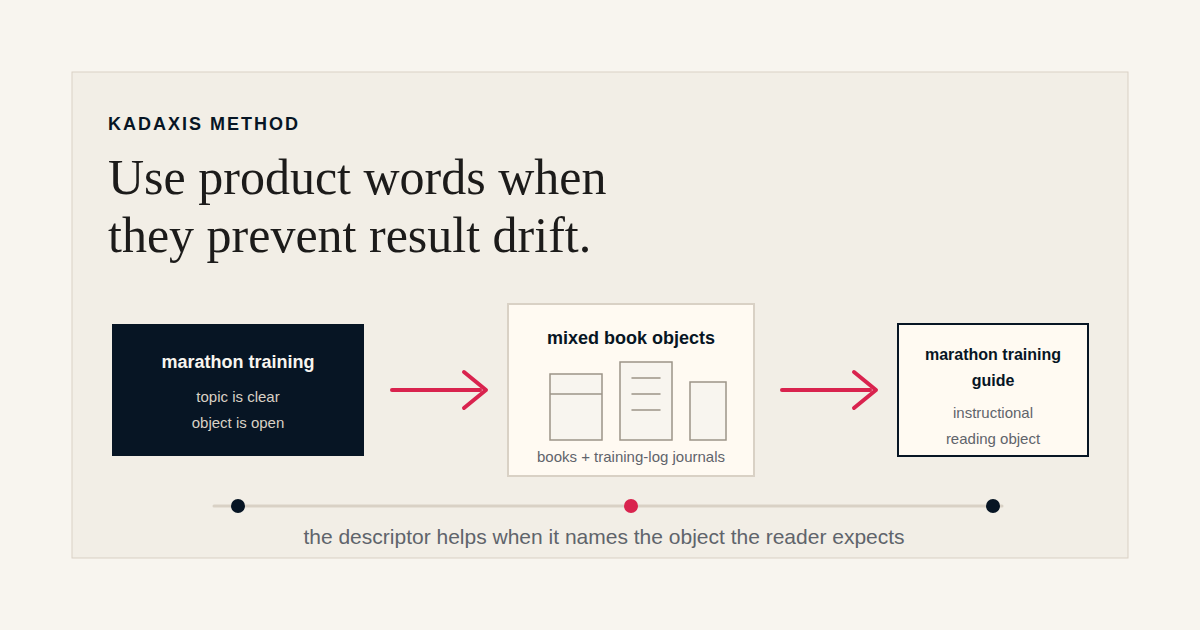
So descriptors can do real work. Whether a given one should go in depends on the book and the query.
When the descriptor does nothing
Two things pull the other way.
The first is redundancy with the catalog. Retailer search already reads the title, subtitle, categories, and description. When the book is already strongly represented as a book, or as a nonfiction work, in those fields, repeating "book" in keyword after keyword adds little. We have written elsewhere about how most keywords fail to add value because they duplicate what the visible metadata already supplies. Product descriptors are one of the most common ways that happens.
The second is typicality. Amazon's research on generated query knowledge filters candidates for whether they reflect how people actually shop, not only whether they are technically accurate. A descriptor that produces metadata language instead of shopper language fails that test. "Distance running nonfiction" parses cleanly and is structurally sensible, but few readers type it. It reads like a catalog field rather than a search.
Two examples
Take two candidates from real keyword work.
distance running nonfiction has three working parts. "Distance running" is the subject. "Nonfiction" separates the book from fiction and memoir. The trouble is that the whole phrase sounds like metadata, not like something a reader types into a search box. Stronger forms depend on what the book actually is:
distance running book
distance running memoir
distance running training book
running nonfiction book
If the book is a memoir, "distance running memoir" fits the intent more closely. If it is instructional, "distance running training book." If it is about the psychology of the sport, "running mindset book." The descriptor should match the object the reader expects, and that object depends on the book.
runner discipline mindset book anchors the product type with "book," which helps, but the phrase is clunky and stacks three separate things: "runner" is the audience, "discipline" is the theme, "mindset" is the psychological angle, "book" is the object. Readers do not search in stacked descriptors. Cleaner candidates:
running mindset book
mental toughness for runners
runner mindset book
running discipline book
The choice among them comes from the result pages. If "mental toughness for runners" returns a set of similar books, it is a stronger pick than "runner discipline mindset book," which likely returns a thinner and noisier set.
When to include "book"
Include "book" when one of these holds:
- The phrase returns more than one kind of object on Amazon. "Running motivation" pulls up motivational books, training journals, wall posters, and slogan apparel. A descriptor like "book" or "guide" tells the system which object the reader wants.
- The phrase drifts toward low-content books. Journals, logbooks, and planners are filed as books, but the reader writes in them rather than reading them. When your book shares a phrase with that category, an object word such as "guide," "memoir," or "training book" separates it.
- The phrase names a need without naming an object. "Discipline for runners" describes what the reader wants to gain. Adding "book" names what they should land on.
- The book competes against other formats Amazon sells under the same phrase: journals, planners, logbooks, workout videos, and, in the default all-departments search, gear and apparel.
Skip "book" when:
- Every keyword in the portfolio already carries it. That is portfolio redundancy, and it crowds out other lanes.
- The phrase is already book-specific. "Running memoir," "marathon training guide," and "sports psychology biography" already name a book object.
- "Book" turns the phrase unnatural. "Runner discipline mindset book" is less typical than "running mindset book."
- The catalog fields already supply the object type strongly and the keyword's real job is a facet the catalog misses. Spend the slot on the missing facet.
When to include "nonfiction"
"Nonfiction" needs more selectivity than "book." It does useful work when it separates the book from fiction, novels, or inspirational narrative. It does little when the phrase already implies nonfiction.
Useful: "running nonfiction," "endurance sports nonfiction," "sports nonfiction."
Redundant: "marathon training nonfiction," "running training nonfiction." Anything carrying "training," "guide," "manual," or "plan" already signals nonfiction. In those cases a precise object word does more than "nonfiction": "training book," "guide," "manual," "plan."
Think in product objects, not just book versus nonfiction
The stronger approach works in product-object precision. The object word should name what the reader expects to receive.
| Descriptor | Use when |
|---|---|
| book | broad object disambiguation |
| nonfiction | the fiction/nonfiction split changes the results |
| memoir | lived-experience narrative |
| biography | life story of another person |
| guide | practical instruction |
| training book | programmatic athletic instruction |
| workbook | exercises, prompts, actions |
| manual | technical or practical reference |
| journal | the reader writes in it |
| devotional | religious daily-use format |
| textbook | formal educational object |
| novel | fiction-object disambiguation |
For a running book, these are not interchangeable:
distance running book
distance running memoir
marathon training guide
running mindset book
mental toughness for runners
endurance sports nonfiction
ultrarunning memoir
runner discipline workbook
Each points to a different product expectation. "Distance running memoir" and "marathon training guide" promise different reading experiences. A reader who wants one will bounce off the other.
The portfolio view
At the portfolio level, the goal is enough product-object anchoring to prevent drift, and no more. Once the portfolio has fixed the object type, the remaining slots go to distinct commercial lanes: audience, outcome, method, substitute intent.
For a distance-running mindset nonfiction book, a strong portfolio might run:
distance running book
running mindset book
mental toughness for runners
endurance sports nonfiction
runner discipline book
long distance running motivation
marathon mindset training
The weak version of the same portfolio:
distance running book
running book
runner book
nonfiction running book
distance running nonfiction book
running nonfiction
runner nonfiction
The second portfolio spends every slot on the same object-and-category lane and covers no audience, no outcome, no method, no substitute intent. It says "this is a running book" seven times and nothing else.
How to decide
The call on any single candidate comes down to a comparison. Run the base phrase and the descriptor phrase, and look at the result pages:
distance running
distance running book
distance running nonfiction
distance running memoir
distance running training book
Then ask whether the descriptor version brings in more genuine book substitutes and pushes out non-book or wrong-object results. If it does, the descriptor is doing intent-preserving work. If the result page barely changes, or if the phrase has become something no reader types, the descriptor is waste. Keep the strongest object form for each lane and drop the rest.
Bottom line
The old rule treated every product descriptor as wasted space. The truer rule is narrower. A descriptor preserves intent when the root phrase is ambiguous, when the result page would otherwise drift to the wrong kind of object, or when the phrase names a need without naming the thing that satisfies it. A descriptor is waste when it repeats what the catalog already says, when it stacks into an unnatural phrase, or when a more precise object word would do the same job better.
"Book" is worth including when it disambiguates the object or prevents drift, and not worth appending everywhere. "Nonfiction" is worth including when the fiction/nonfiction split affects the results, and otherwise gives way to a more precise object: memoir, guide, workbook, training book, manual. The keyword field is too small to spend on words the catalog already knows. It is also too valuable to strip of the one word that tells a shopper they have found the right kind of book.