
Publishers have long operated on a simple rule: Amazon only reads the first 250 characters of ONIX keywords, so anything past that is wasted effort. It is a convenient belief. The data does not support it.
We looked at 4,052 high-selling books published in the last three years. Nearly half carried 400 or more characters of ONIX keyword text. If the cutoff were real, a lot of publishers were spending a lot of effort on nothing.
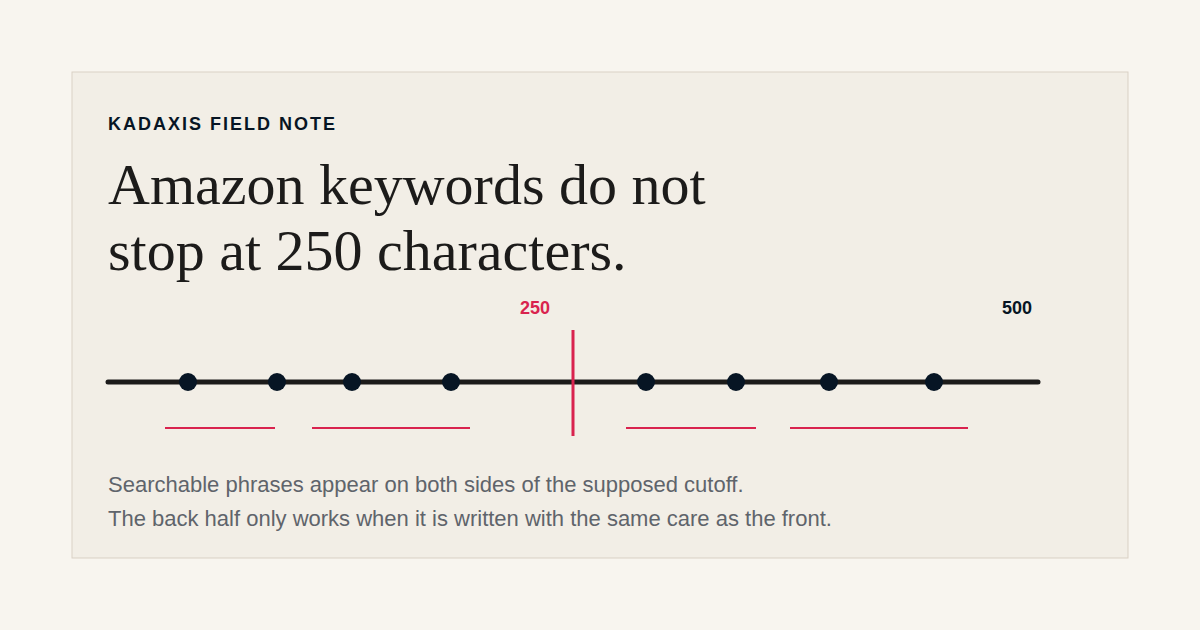
To test it directly, we pulled keyword phrases from before and after the 250 mark and ran them through Amazon search. Post-250 phrases surfaced books at roughly the same hit rate as pre-250 phrases. Whatever Amazon is doing with the field, a hard 250 cutoff is not it.
There was one ranking difference: phrases inside the first 250 tended to rank better when they hit. The easy interpretation is that Amazon weights early phrases more heavily. There is a simpler explanation that fits the same data.
When someone writes keywords by hand, the first phrases out are usually the strongest. They have been thinking about the book. They know the obvious shopper queries. By the time they are 25 phrases in, they are reaching. The middle of the field thins out. The tail tends to be padding. The pre-250 rank advantage may have less to do with Amazon's algorithm and more to do with where publisher attention runs out.
That changes the takeaway. The lesson is not to stop at 250. The lesson is to keep going until the phrases actually thin out, and most publishers run out of good ideas long before they think they have.
Most of the keyword fields we reviewed showed the same problem. Generic terms like "mental health books," BISAC-adjacent category fragments, restatements of the title, author and award leakage, and the occasional CSS fragment nobody noticed. When publishers test their own keyword work and see weak results, they conclude keywords don't matter. What the data shows is that the keywords being tested were not very good to begin with.
The practical target is a keyword field of roughly 400 to 500 characters where every phrase has a clear job. Specific long-tail terms. Secondary use cases. Audience segments. Problem and solution language. Comparable reader interests. Phrases an actual shopper would actually type. The publishers running fields like this are giving their books materially more credible paths to the shopper who would buy them. Publishers stopping at 250 are not playing it safe. They are leaving search visibility on the table for any competitor willing to do the work.
The publishers gaining ground in Amazon search right now are not writing longer keyword fields. They are writing fields where the back half is as good as the front, all the way to 500.