
The most common question we hear from publishers is some version of: will this book rank for this keyword?
It is a fair question. It is also two questions in one, and the work of any serious keyword strategy starts by pulling them apart.
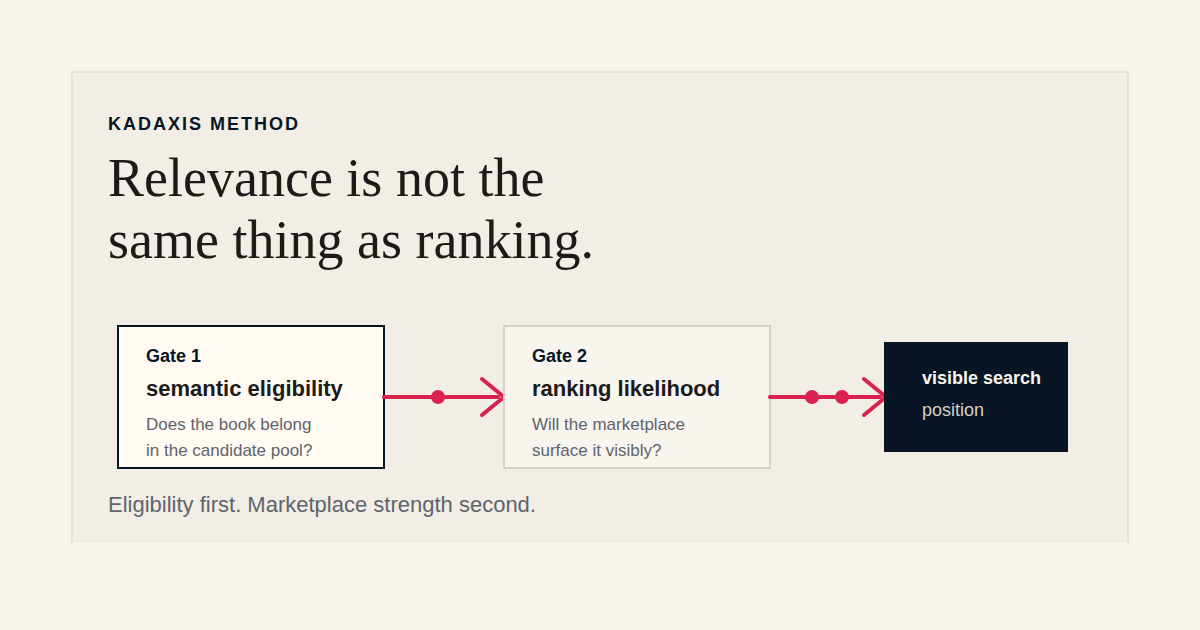
The two questions are these. First: can the search engine plausibly understand this book as relevant to this query? Second: will the search engine actually choose to surface this book, in a position visible to the reader, against everything else competing for the same query? The first is a question about meaning. The second is a question about marketplace selection. Both matter. They are not the same.
We have started calling the first question semantic eligibility and the second ranking likelihood, and the labels are useful because they keep separate things separate.
A book is semantically eligible for a query when its metadata, category positioning, and surrounding signals plausibly fit the reader intent behind the query. A grief memoir is eligible for "books about losing a spouse." A beginner watercolor guide is eligible for "watercolor techniques for beginners." A middle-grade fantasy with dragons is eligible for "dragon adventure books for kids." Eligibility does not mean the book will rank high enough to be seen. It means the book belongs in the candidate pool the engine is choosing from.
Ranking likelihood is the second gate. Among all eligible books for a given query, which ones get surfaced first? That selection is shaped by relevance, but also by sales velocity, conversion rate, review count and rating, recency, format availability, price, advertising, category traction, author and series recognition, and the cover and product-page elements that drive click-through. Some of those signals are public. Some are partial. Some are not visible at all to anyone outside the marketplace itself.
Two gates, in sequence. A book that fails Gate 1 cannot pass Gate 2. A book that passes Gate 1 is in the running for Gate 2 but is not guaranteed to win it.
This sequence is why so many keyword strategies fail silently. A publisher invests in advertising, promotion, and merchandising for a book that is not semantically eligible for the queries the campaign targets, and performance does not move. The reasonable inference is that the campaign is underfunded or poorly targeted. The actual cause is upstream: the marketplace search system has weak evidence that the book fits the query in the first place, so no amount of demand-side investment can pull it into a ranked position. The campaign was pushing against the engine's understanding of the book, not with it.
The reverse failure also happens. A publisher does the metadata work to make a book semantically eligible for a high-value query, and the book does not appear high in search results. The reasonable inference is that the metadata work was wasted. The actual cause is also upstream: eligibility is necessary but not sufficient, and the book has not yet built the marketplace strength to outrank stronger competitors for that particular query. Time, sales, reviews, and category traction may eventually pull it forward. The metadata work was not wasted. It was the foundation; the rest of the work was demand-side.
For a publisher trying to allocate keyword effort, the practical sequence looks like this:
First, identify the searches a book is genuinely eligible for. This is the reachable keyword universe. Without eligibility, no other work can help.
Second, prioritize within that universe by commercial value, query specificity, and competitive density. Some eligible searches are not worth pursuing because the result set is too crowded with stronger products. Some are worth pursuing because the demand is real and the competition is thin. The scoring is different from search volume alone.
Third, make the book's relevance clearer to the marketplace where it can be made clearer. This is the metadata work: title, subtitle, description, category selection, subject framing. The goal is not to stuff every plausible keyword into the product page. The goal is to make the book's actual subject, audience, genre, use case, and promise legible enough that a search engine can connect it to the right reader intents.
Fourth, layer demand-side investment (advertising, promotion, merchandising, reviews, conversion optimization) on top of a foundation of clear eligibility. This is where ranking likelihood gets built.
Done in this order, the work compounds. Done out of order, individual investments fight each other.
A useful diagnostic when evaluating a vendor or an internal keyword tool is to ask which gate the tool is operating on. If the answer is "we predict which keywords your book will rank for," the tool is making a Gate 2 claim that depends on marketplace performance variables most tools cannot see. The output may still be useful, but the claim is overstated. If the answer is "we identify the searches your book is genuinely eligible for and prioritize the ones worth pursuing," the tool is operating on Gate 1 with appropriate humility about Gate 2. The latter is the more honest claim and, in our experience, the more durable foundation for actual performance gains.
A note on long-tail queries, which are the kind of search where the distinction between the two gates is easiest to see in practice. Broad queries (one or two words, large categorical labels like "romance" or "business" or "fantasy") have result sets in the tens or hundreds of thousands of books. Ranking high for those queries is dominated by marketplace strength because the eligibility pool is enormous and most of the differentiation between visible and invisible books comes from demand-side signals. Long-tail queries, by contrast, are specific. They use multi-concept descriptions and intent-laden language: phrases like "leadership books for first-time managers" or "sad story with happy ending," where the reader has assembled multiple constraints into a single query. The result sets are correspondingly smaller, sometimes a few hundred books or fewer. In small result sets, eligibility does more of the work, because the competing pool is small enough that relevance-based selection dominates over popularity-based selection.
Long-tail keyword work tends to produce more measurable results than broad-keyword work because the gap between eligibility and ranking is much narrower at the long-tail end of the distribution. A book that becomes eligible for a specific long-tail query is much more likely to actually appear visibly for that query than a book that becomes eligible for a broad head term. The investment converts into visible ranking faster.
There is a second reason long-tail keyword work tends to outperform broad-keyword work, and it sits on the demand side rather than the supply side. A reader typing "leadership books for first-time managers" already knows what they are looking for. The query itself is the specification. The reader has identified a need (leadership development), narrowed it to a format (books, not articles or courses), and qualified it by audience (first-time managers, not seasoned executives). They are close to a purchase decision, looking for the right book to fill an already-defined gap. A reader typing "business" is doing something different: browsing, exploring, sometimes figuring out what they actually want. Both are real readers. They are at different stages of the buying funnel. Long-tail keyword work targets the readers closest to conversion, which is part of why the same impression at the long-tail end of the distribution converts at a much higher rate than the same impression on a head term.
The implication, which sounds obvious once stated but is rarely how keyword strategies are actually run: keyword work should start at the long tail and build inward toward the head, not the other way around. The long tail is where eligibility produces visible results most directly, and where the readers most likely to convert are doing their searching. Once a book has accumulated category traction across a wide base of long-tail queries, the marketplace strength to compete for broader queries follows. Starting at the head is starting at the gate where the work is hardest and the conversion from investment to visibility is slowest.
The honest summary, which we tell every new client some version of: we cannot promise that your books will rank for the queries we identify. What we can promise is that the queries we identify are ones your books are genuinely eligible for, prioritized by where the eligibility-to-ranking gap is narrowest. The rest of the work is demand-side, and it sits with the publisher's marketing investment, not with us. The two functions are complementary. They are not interchangeable.
Most of what looks like a keyword problem is actually one of these two distinct problems being mistaken for the other. Naming them separately is not splitting hairs. It is the first step toward doing each one well.