
The short version
- We counted 2,410,330 keywords across 94,385 books and measured the length of each one.
- Single-word keywords make up 44.57% of the total, by far the largest share. Together, one- and two-word keywords make up 72.84%.
- A quarter of the books carry no keywords at all. 25,059 books, or 26.55%, have none.
- When publishers use the field, they add a median of 26 keywords per book and an average of 35.
- Keywords that make books appear in Amazon search look different. In the sets we build, 92% are three or four words long. Publisher keywords cluster at one and two words.
Publishers spend real time on keywords. The numbers prove it: 2.4 million keywords, a median of 26 per book, and 428,949 unique keywords overall. Somebody sat down and filled those fields.
We wanted to see what those fields contained. We analyzed every keyword supplied for 94,385 books, counted the words and characters in each one, and measured how publishers mixed single-word keywords with longer ones. This study measures structure only. It does not ask whether readers search for a keyword, whether it fits the book, or whether the book ranks for it.
Even that tells us a great deal.
A quarter of the books carry no keywords
Start with the books that have none. Of 94,385 books, 25,059 have no keywords at all. That is 26.55%, more than one book in four.
Adding keywords costs nothing but time and gives readers another way to find the book. Leaving the field empty removes that opportunity. Whatever the quality of the other keywords, more than a quarter of these books get no benefit from the field.
The rest of the analysis covers the 69,326 books that have keywords.
Publishers assign a median of 26 keywords per book
Books with keywords have a median of 26 and an average of 34.8. The average is higher because some books have very large keyword sets.
These numbers show that publishers do not neglect the field. They work at it. The question is what the work produces.
Single words take the largest share
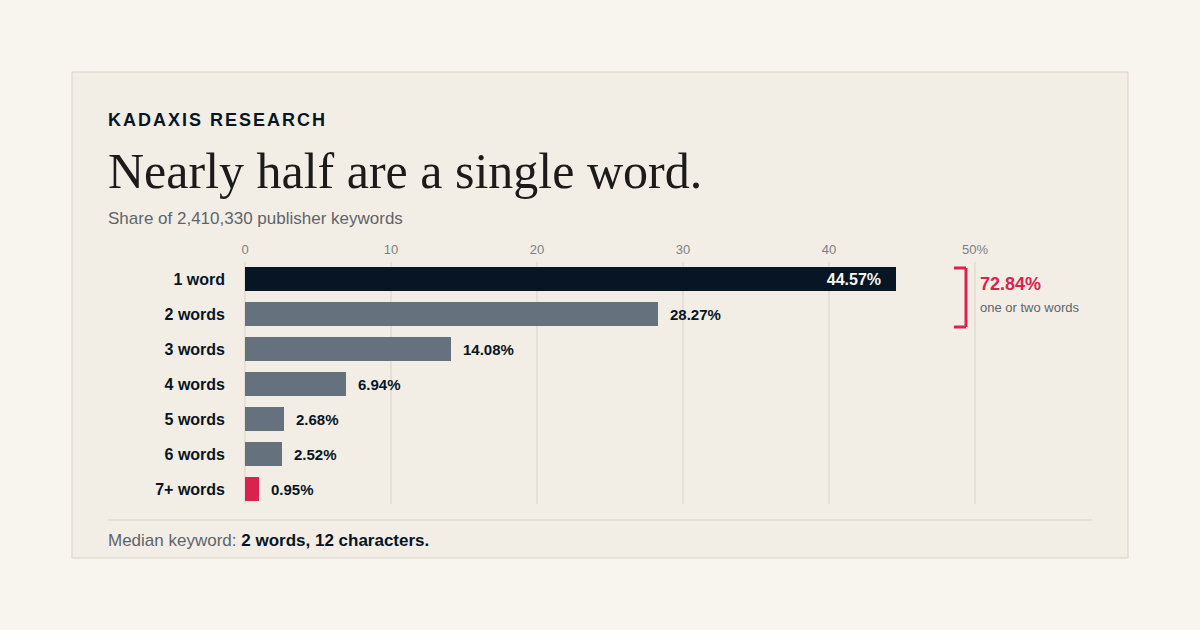
Of the 2,410,330 keywords, 1,074,238 are a single word. That is 44.57%, and no other length comes close.
| Words in the keyword | Keywords | Share |
|---|---|---|
| 1 | 1,074,238 | 44.57% |
| 2 | 681,441 | 28.27% |
| 3 | 339,301 | 14.08% |
| 4 | 167,304 | 6.94% |
| 5 | 64,496 | 2.68% |
| 6 | 60,630 | 2.52% |
| 7 or more | 22,920 | 0.95% |
A single word names a shelf. A keyword like "history" puts one title against every history book in the catalog, with little chance of reaching the top. Publishers use nearly half their keywords this way, an average of 15 single-word keywords per book.
Two-word keywords are next at 28.27%. Together, one- and two-word keywords make up 72.84% of the total. The average keyword is 2.111 words and 13.6 characters long. The median is 2 words and 12 characters.
Keywords longer than one word make up 55.43% of the total, but most are still short. Of these longer keywords, 76.40% contain only two or three words.
Publisher keywords are short. Most are single words or brief pairs, not the specific phrases readers type into a search box.
Most books mix single words and longer keywords
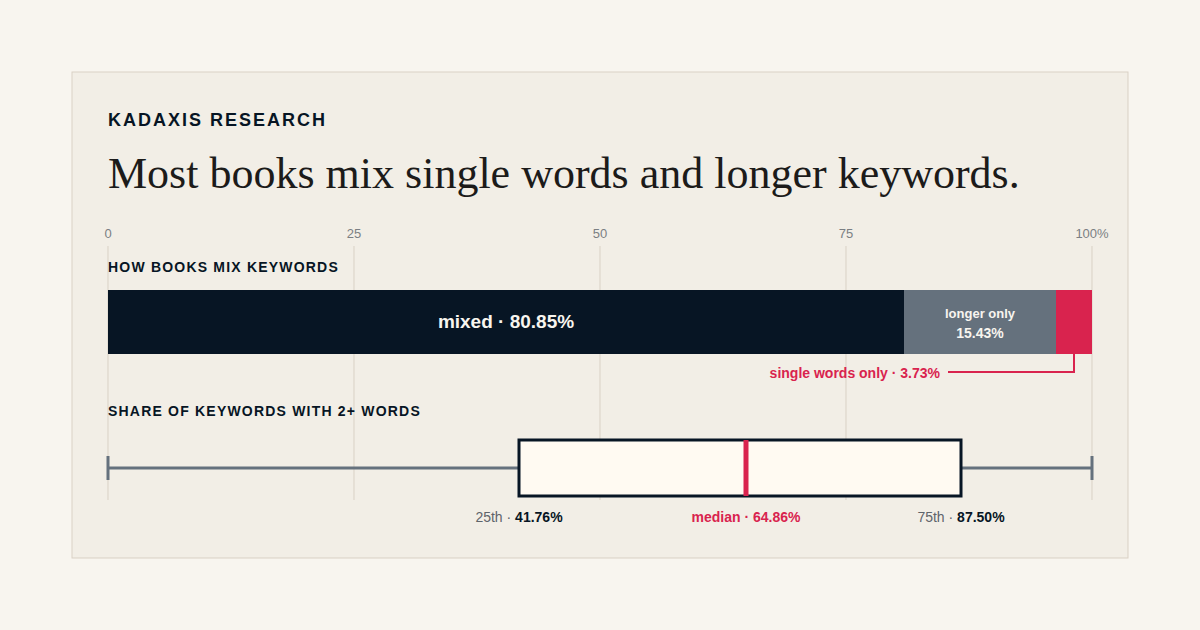
Most books use both forms. Among books with keywords, 80.85% have at least one single-word keyword and at least one longer keyword. Only 3.73% use single-word keywords alone, while 15.43% use only longer keywords.
In the median book, 64.86% of the keywords contain two words or more. Among the middle half of books, that share ranges from 41.76% to 87.50%.
The wide range reflects different publisher styles. Some publishers write mostly single words, others mostly phrases, and most write both. What unites them is length. Whichever form a publisher favors, the individual keywords stay short.
Read against what ranks
This study measures keyword length. A separate study measured whether keywords made books appear in Amazon search.
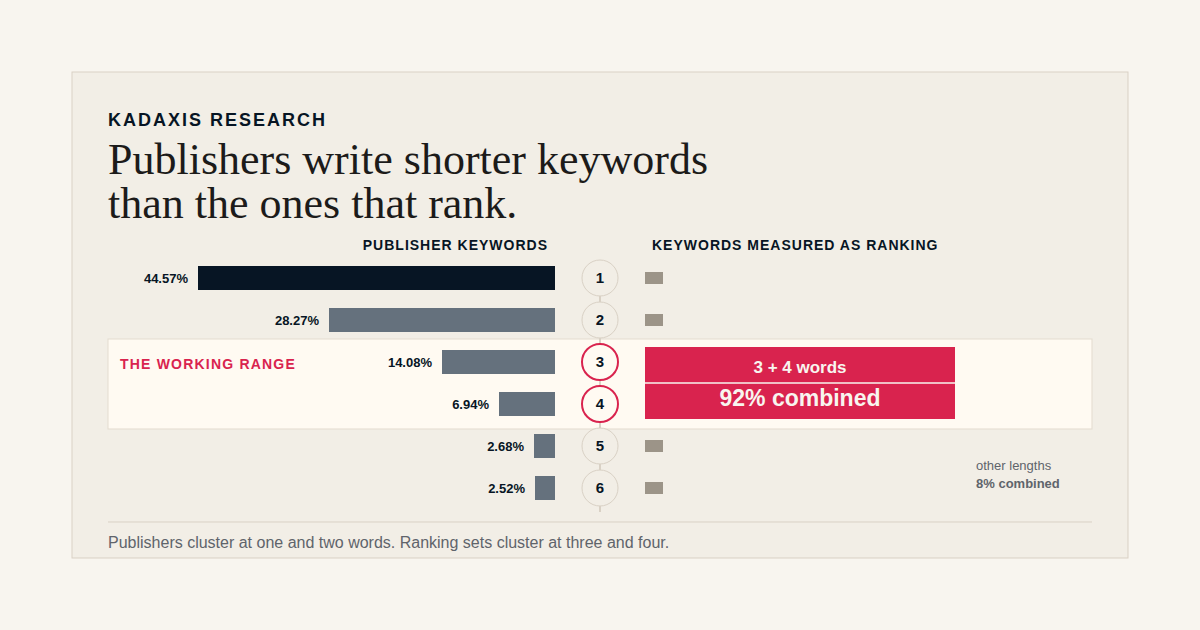
In our Amazon research, we tested 248,046 publisher keywords across 24,367 books. For each keyword, we checked whether the book appeared in the first two pages of Amazon Books results. About 8% made the book appear. In the sets we build, 42% did, and 92% of the keywords were three or four words long.
The difference is clear. Keywords that make books appear cluster at three and four words. Publisher keywords cluster at one and two. The two ranges barely overlap.
The comparison points to an explanation, but does not prove it because the studies used different sets of books. The reason is straightforward. Two-word keywords rarely narrow the results enough for one book to compete. Three- and four-word phrases can name the subject, angle, audience, or use a reader wants.
Publishers already write enough keywords. Most are simply too short to compete.
What we would change
Three changes follow from the data.
Fill the empty fields. A quarter of these books have no keywords. Filling them costs nothing but time.
Use fewer single-word keywords. Nearly half of all publisher keywords are a single word, an average of 15 per book. A few broad terms may help categorize a book. Fifteen add almost nothing in search.
Make the rest longer. Shift from two-word keywords to three- and four-word phrases. Longer phrases can name the audience, problem, setting, or use alongside the subject.
None of this requires more effort than publishers already spend. It requires spending it differently. The fields are full. The words in them are short.
Method. We analyzed ONIX keywords for 94,385 books. We converted each keyword to lowercase, removed extra spaces and exact duplicates within each book, then counted its words and characters. We also measured how each book mixed single-word and longer keywords. Publishers usually separate keywords with semicolons, line breaks, or pipes. A small number use commas. Only 0.152% of the keywords contain commas. Treating those commas as separators changes the single-word share from 44.57% to 44.65%, so none of the conclusions change. We counted each edition separately. This study measures keyword length and structure only. It does not measure whether a keyword fits a book, how often readers search for it, how competitive it is, or whether the book appears in search results.