
Key findings
- We built Amazon keyword sets for 2,000 books using the Kadaxis method and searched every one. 42% ranked in the top Amazon Books results. Publisher-assigned keywords, measured the same way, rank at about 8%. More than five times the visibility.
- The 8% baseline was not weak books. Those 24,367 titles were strong recent sellers, and their keywords still mostly returned nothing: the median book ranked for zero of its assigned keywords. The median book in the client set ranked for 42% of its keywords.
- The difference is how the keywords are created. Publisher keywords read like catalog labels: "fiction books," "gifts for her," "books for 7 year old girls." Client-set keywords read like real reader searches: "renal smoothie recipes," "technical rappel anchors," "public land elk hunting."
- Keywords work. The common way of choosing them does not, and almost no one measures whether it does. Kadaxis does.
For publishing leaders: Keyword coverage is not the same as search visibility. Check whether the supplied terms actually surface the intended books.
Recent Kadaxis research put a number on how often publisher-assigned keywords rank in Amazon search. Across a large baseline set, about eight percent produced a visible result when the keyword was searched. The other ninety-two percent returned nothing that surfaced the book.
Numbers like that are why plenty of people in publishing have quietly decided keywords are theater. The conclusion is fair, and it is wrong. Keywords work. The way they are usually chosen fails, and it fails so reliably that it makes the whole tool look broken. To show the size of the gap, we built the keywords for 2,000 books from a recent publisher client the Kadaxis way, and ran the same test. That means starting from what the book offers a reader, checking candidate phrases against how Amazon actually returns books, and keeping the phrases with a realistic path to visibility instead of filling the field with broad category labels.
The test
We built the keyword sets for 2,000 books for a recent publisher client. The list is diverse: fiction and nonfiction, across many genres and categories, from practical guides to narrative history to novels. For each book, we searched every delivered keyword on Amazon Books, read the top two result pages, and recorded whether the book appeared. A book counted as ranking for a keyword if any of its editions surfaced, whether Kindle, paperback, hardcover, or audiobook.
This is the same test behind the eight-percent baseline, and that baseline is both large and strong. It covers 24,367 books and 248,046 unique book-keyword pairs of publisher-supplied ONIX keywords, and those titles were selected for having real sales over the previous three years. Strong-selling books, with keywords assigned the usual way.
The result
Across the 2,000-book client set, forty-two percent of delivered keywords ranked in the top two Amazon Books pages. The publisher-assigned baseline ranked at about eight percent on the same measure. Kadaxis-built client keywords surfaced the book more than five times as often.
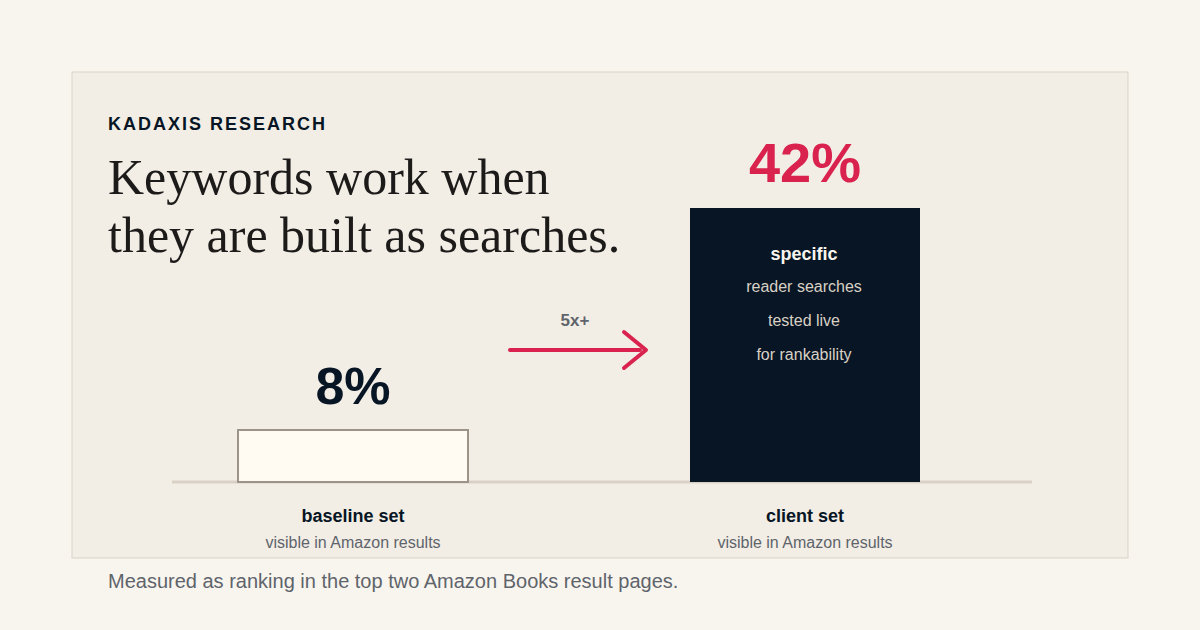
The book-level split is wider than the pooled rate. The median book in the publisher-assigned baseline ranked for none of its assigned keywords: zero. Sixty-four percent of those books had no ranking assigned keyword at all. The median book in the client set ranked for forty-two percent of its keywords.
The baseline books were the strong sellers, and most of their assigned keywords still returned nothing. Sales did not rescue a weak keyword. A book can move thousands of copies and stay invisible for the specific queries its metadata was supposed to capture.
Why forty-two and not one hundred
If the keywords are built well, why do fewer than half of them rank?
No keyword set ranks for everything, and a good one does not try to. The measurement is a snapshot at shallow depth: two pages, roughly the top forty-eight results. A keyword sitting at position sixty counts here as a miss while still being indexed and climbing. A strong set also spans a range of difficulty on purpose, because Amazon rewards relevance and sales history together. Some keywords target competitive spaces a book grows into as it sells, and carrying a few of those is how a book keeps gaining ground instead of stalling. Forty-two percent is a floor, measured at shallow depth at one moment, and it rises as the book grows into harder searches.
What makes the difference
The gap comes from what the keywords are.
Start with query shape. In the publisher-assigned baseline, forty-five percent of keywords are one or two words long. In the client set, ninety-two percent are three or four words. The length gap points to a deeper one: short keywords tend to be broad category labels, and specific reader searches run three or four words. "Romance" is a shelf. "Regency romance with a spy" is a search.
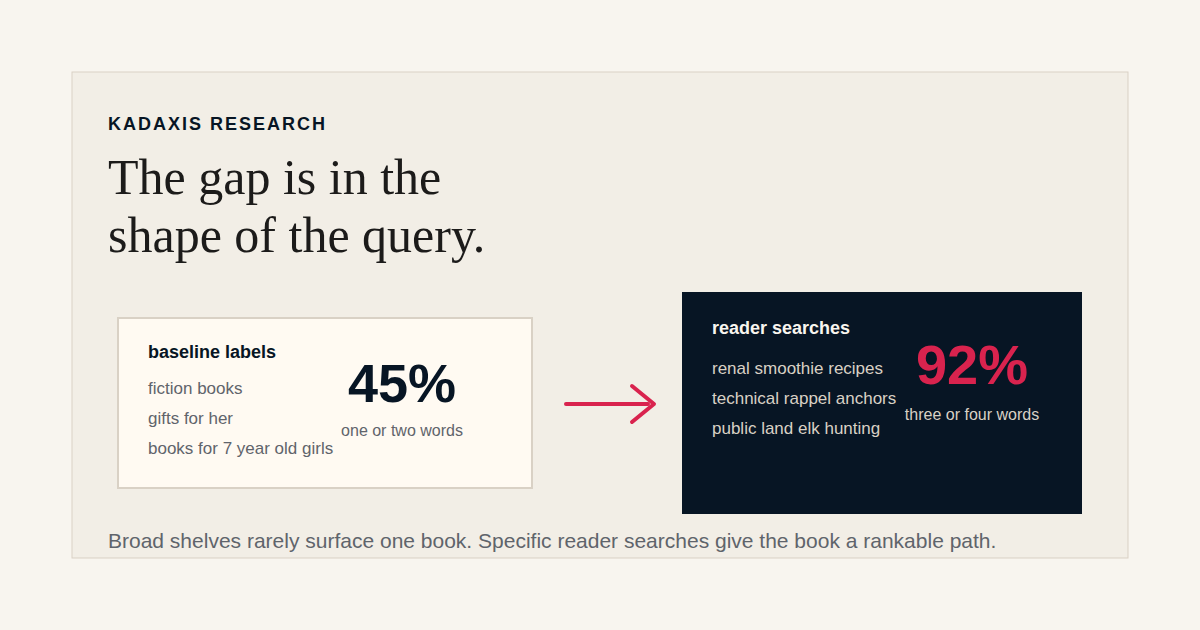
The publisher-assigned inventory is full of recognizable patterns that do not rank:
Broad store categories, like "fiction books," "romance books," "health books." The book is one of hundreds of thousands of equally eligible results, and it does not surface.
Demographic shelves, like "books for women," "books for 7 year old girls," "kids books ages 9-12." These describe a shelf, not the book, and the book competes against the whole shelf.
Gift and merchandising phrases, like "gifts for her," "stocking stuffer," "best books." These chase a shopping occasion rather than the book's subject.
Adjacent but unsupported topics, like "pearl harbor" attached to a Civil War book, or "horror movies" attached to a horror novel. The topic is nearby, the medium or the subject is wrong, and the query returns something else.
A large share of the baseline keywords contain "book," "books," or "kindle," often bolted onto a broad category: "fiction books," "romance books," "yoga book." Sometimes "book" is the right call, as we have written, when it keeps a phrase from drifting toward journals, gear, or other products. It does not fix breadth. "Fiction books" fails for the same reason "fiction" fails: too many titles are eligible, and this one has no realistic path to surface.
The takeaway looks simple: write reader phrases, not category labels. That is only the easy half. The harder part is knowing which searches a given book can actually rank for. "Technical rappel anchors" ranks; "canyon adventure book" reads plausibly and returns nothing. They look similar on the page. The difference depends on demand, competition, and whether Amazon reads the book as relevant, none of which is visible from the phrase alone. The publisher-keyword baseline is what capable people produce when they write their best guess. The gap closes only when guesses are tested against what Amazon actually returns.
The same pattern, book by book
The gap shows up book by book, and the pattern runs across the whole 24,367-book baseline, at publishers large and small. When a publisher-assigned keyword does rank, the hit is usually the book's own author, its own title, or a term so broad it means nothing: the book finding itself, or finding a shelf, instead of being found by a reader searching for what it is about. The named examples below illustrate that pattern rather than singling out any one house.
The baseline titles below are public books from the strong-selling comparison set. The client books beside them are matched by subject and described by type. Every keyword shown ranked in Amazon search, on the same test.
Across the seven baseline examples used for this table, 292 of 302 assigned keywords did not rank. The few that did rank were usually author, title, series, or shelf terms rather than useful reader-intent searches.
| Client book type | Ranked / missed | Sample of what ranked | Baseline book | Ranked / missed | What ranked |
|---|---|---|---|---|---|
| Kidney-health smoothie cookbook | 16 ranked 1 missed |
renal smoothie recipes; low potassium smoothies; smoothie recipes for ckd; smoothies for dialysis patients | Yoga for Osteoporosis | 1 ranked 22 missed |
"yoga poses," a term too broad to place the book |
| Canyoneering skills guide | 20 ranked 0 missed |
technical rappel anchors; dry canyon route finding; wet canyon safety; slot canyon techniques | Dogsledding and Extreme Sports | 2 ranked 19 missed |
"extreme sports"; "iditarod books for kids" |
| Regional haunted-history guide | 16 ranked 0 missed |
oklahoma theater hauntings guide; ranch hauntings oklahoma; urban legends oklahoma; spooksville triangle tales | A Head Full of Ghosts | 1 ranked 37 missed |
the author's own name |
| Historical pirate novel | 12 ranked 7 missed |
physician turned pirate; tortuga pirate leader; romantic pirate adventure; classic sea romance | Don't Know Much About the Civil War | 1 ranked 36 missed |
one malformed string, nothing about the Civil War |
The volume cases make the same point at the extreme. One bestselling contemporary romance, A Lowcountry Bride, carried eighty-four assigned keywords and ranked for none of them. A young-adult novel, Spellhacker, carried seventy-eight and also ranked for zero. Their fields were full, and every slot returned nothing.
So, do keywords work?
Yes. The doubt is fair, because most people in publishing have only seen the common approach, and the common approach fails at a rate that makes keywords look like decoration.
Two things separate a keyword that ranks from one that does not. The first is how it is built. Publisher-assigned keywords tend to read like catalog metadata: shelves, audiences, categories, occasions. The client keywords read like reader searches: specific, tied to the book, phrased the way a person types. That difference alone separates a field that surfaces the book from one that returns nothing.
The second is whether anyone checks. In most cases, keywords are entered once and never searched to see whether a single one surfaces the book. The eight-percent rate survives because almost no one looks. Measuring against live Amazon search is the core of how Kadaxis works, and a study like this one is what that measurement produces.
Built as real reader searches and tested against the marketplace, keywords surface the book more than five times as often. For a publisher, keyword quality is discovery infrastructure. A backlist with broad, untested, invisible keywords waits for readers who already know the title, author, or series. A backlist with keywords built around real searches, checked against Amazon, has far more ways to be found.